
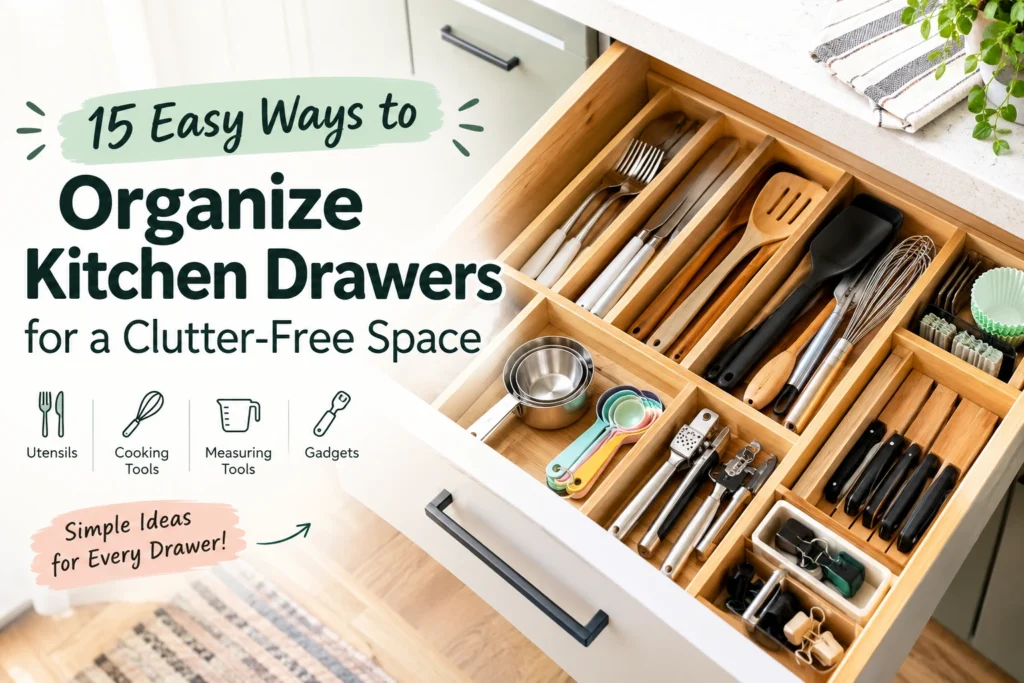
Kitchen drawers can quickly become one of the messiest parts of a kitchen. Utensils get mixed together, cooking tools disappear underneath larger items, and deep drawers often turn into catch-all storage.
Learning how to organize kitchen drawers is less about buying lots of organizers and more about creating simple storage zones that make everyday items easy to find and put away.
Whether you have a small kitchen, deep drawers, wide pull-out drawers, or a busy family kitchen, the right system can make your cabinets and drawers feel much more manageable.
In this guide, you’ll find 15 practical ways to organize kitchen drawers, including solutions for utensils, deep drawers, small drawers, cooking tools, and pull-out storage. You’ll also learn how to decide which drawer organizers are actually useful for your space.
How to Organize Kitchen Drawers Step by Step
Before adding organizers, take everything out of the drawer you’re working on. This makes it much easier to see what you actually have and what is taking up unnecessary space.
Use this simple process:
-
Empty the drawer completely.
-
Group similar items together.
-
Remove broken, duplicate, or rarely used items.
-
Measure the drawer’s width, depth, and height.
-
Decide which items belong in that drawer.
-
Choose organizers based on what you actually need.
-
Put frequently used items in the easiest-to-reach areas.
Start with one drawer rather than trying to reorganize the entire kitchen at once. Once one drawer has a system that works, you can repeat the same approach throughout the kitchen.
1. Use Drawer Dividers for Everyday Utensils
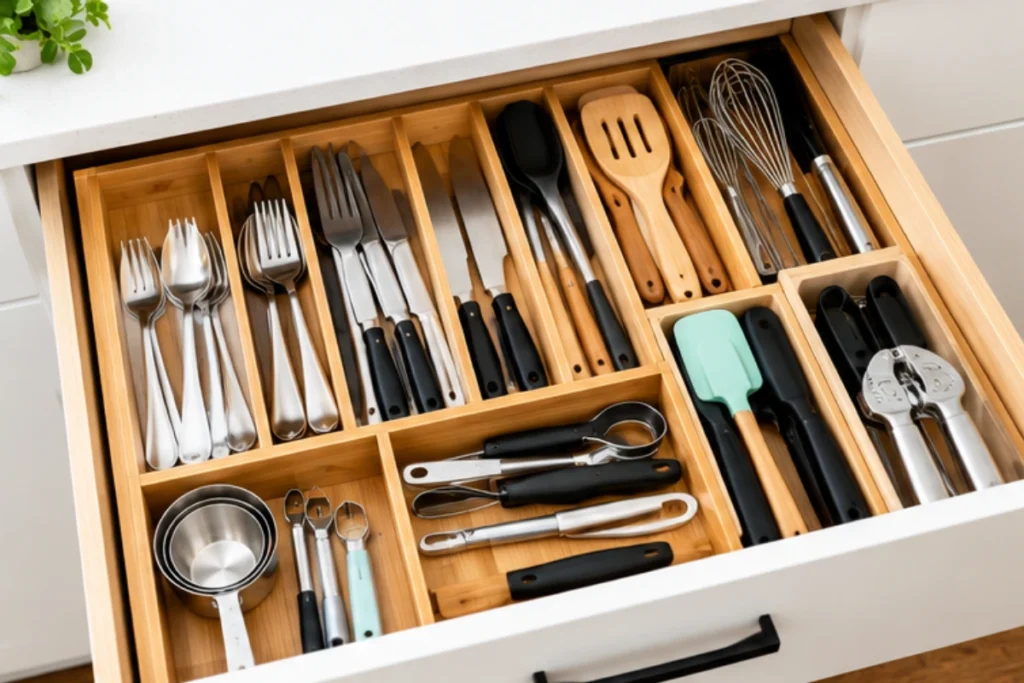
One of the easiest ways to organize kitchen drawers is to separate everyday utensils into clear sections.
Instead of placing forks, spoons, knives, and serving utensils together, use a divided tray or adjustable drawer dividers to create individual zones.
For example, one section can hold:
-
Dinner forks
-
Spoons
-
Table knives
-
Measuring spoons
-
Serving utensils
Choose a layout that matches the utensils you actually use rather than forcing every drawer into the same configuration.
Tip: Put your most frequently used utensils toward the front of the drawer so they are easy to grab.
2. Organize Kitchen Utensils by Function
Not every kitchen tool needs to be stored according to its shape. Organizing utensils by function can make cooking easier.
You could create separate sections for:
-
Cooking utensils
-
Baking tools
-
Measuring tools
-
Food preparation tools
-
Serving utensils
For example, measuring cups and measuring spoons can stay together instead of being scattered across different drawers.
This approach is especially helpful if you cook regularly because similar tools remain together when you need them.
3. Add Adjustable Drawer Organizers
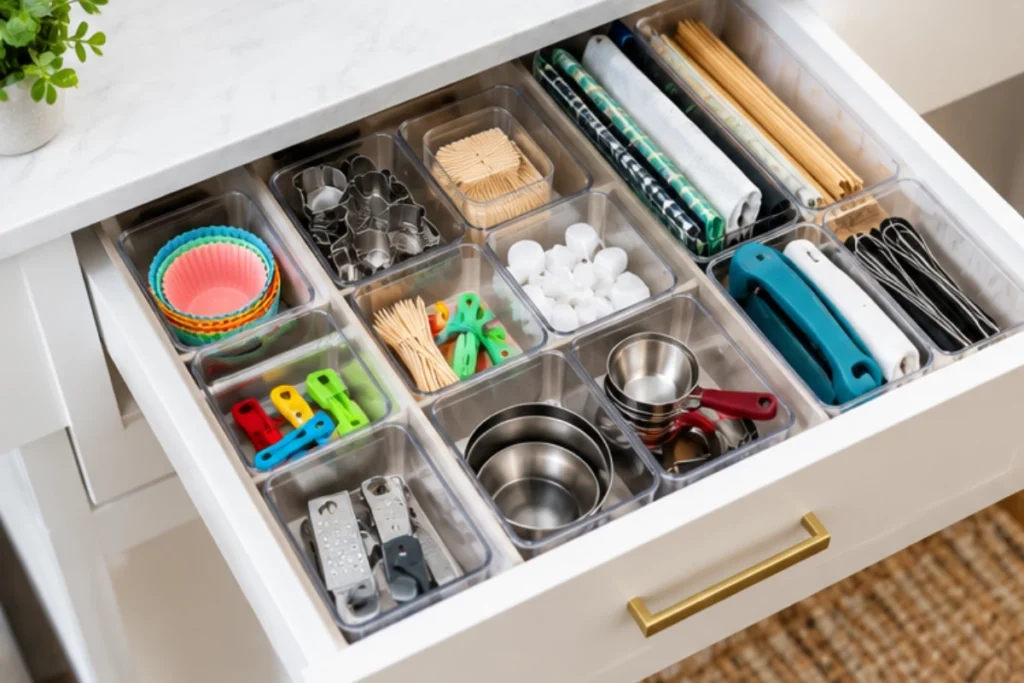
Adjustable organizers are useful when your drawer contains items of different sizes.
Unlike fixed trays, adjustable dividers can usually be moved to create wider or narrower sections.
This makes them practical for drawers containing a mixture of:
-
Spatulas
-
Tongs
-
Whisks
-
Peelers
-
Measuring tools
-
Kitchen gadgets
The goal isn’t to fill every inch of the drawer. Leave enough room for items to be removed without disturbing everything else.
4. Create a Dedicated Kitchen Gadget Drawer
Small kitchen gadgets can easily take over several drawers when they don’t have a designated home.
Choose one drawer for smaller tools such as:
-
Garlic presses
-
Citrus juicers
-
Vegetable peelers
-
Can openers
-
Graters
-
Small thermometers
-
Kitchen scissors
Before assigning a drawer to gadgets, remove items you rarely use.
If you have three versions of the same tool, keeping the one you actually prefer can free up more space than buying another organizer.
5. Organize Deep Kitchen Drawers with Zones
Deep drawers can hold larger kitchen tools, but they can also become difficult to manage because items tend to stack on top of each other.
Instead of putting everything into one large open area, divide the drawer into zones.
For example:
Front zone: Frequently used tools
Middle zone: Larger cooking utensils
Back zone: Less frequently used items
You can also use long dividers or separate containers to prevent items from shifting around.
If the drawer is deep enough, make sure items remain visible rather than creating several layers of tools.
When learning how to organize kitchen drawers, deep drawers work best when you divide them into clear zones instead of stacking everything together.
6. Use a Knife Organizer Instead of a Loose Knife Drawer
Loose knives can make a drawer difficult to use and can create an unnecessary safety concern.
A dedicated in-drawer knife organizer can keep blades separated and handles easy to identify.
Choose a design that fits your drawer and keeps knives securely positioned.
If you have children in the home, consider the overall safety of your knife-storage setup and choose an option appropriate for your household.
7. Give Measuring Cups and Spoons Their Own Section
Measuring tools are small enough to become mixed together quickly.
Create one dedicated section for:
-
Measuring cups
-
Measuring spoons
-
Liquid measuring tools
-
Small kitchen scales or related accessories
You can arrange measuring cups by size or stack compatible cups together.
For measuring spoons, a small divided section or organizer can prevent them from becoming buried underneath larger utensils.
8. Organize Kitchen Drawers by Frequency of Use
One of the most useful organization principles is simple: store frequently used items where they are easiest to reach.
For example:
Daily use: Front and upper drawers
Weekly use: Middle drawers
Occasional use: Deeper or less convenient storage
There’s no reason to give prime drawer space to an item you use twice a year.
This approach also makes everyday cooking faster because the tools you reach for most often are always in predictable locations.
9. Use Small Containers Inside Larger Drawers
A large drawer doesn’t always need one large organizer.
Small containers can create flexible zones for items such as:
-
Bag clips
-
Corn holders
-
Small measuring tools
-
Reusable straws
-
Kitchen gadgets
-
Bottle openers
-
Small accessories
Choose containers that fit securely inside the drawer and don’t slide around every time you open it.
This method can be particularly useful when a standard cutlery tray doesn’t match the drawer’s dimensions.
10. Organize a Small Kitchen Drawer Without Wasting Space
Small drawers require more careful planning because every inch matters.
Start by measuring the drawer before buying an organizer. Then prioritize the items you use most frequently.
A compact drawer might work well for:
-
Measuring spoons
-
Peeler
-
Can opener
-
Kitchen scissors
-
Small utensils
Avoid using a large organizer simply because it has many compartments. An oversized tray can actually reduce usable storage space.
For small kitchens, the best organizer is the one that fits your drawer and your actual belongings.
This simple approach makes how to organize kitchen drawers much easier, even when every inch of storage space matters.
11. Make a Dedicated Baking Drawer
If you bake regularly, consider creating a drawer specifically for baking tools.
You could store:
-
Measuring cups
-
Measuring spoons
-
Rolling accessories
-
Pastry tools
-
Cookie cutters
-
Small spatulas
-
Decorating tools
Keeping these items together makes it easier to prepare for baking without searching through multiple drawers.
If you don’t bake often, this drawer could instead become a general-purpose cooking-tool drawer.
12. Organize Large Pull-Out Kitchen Drawers
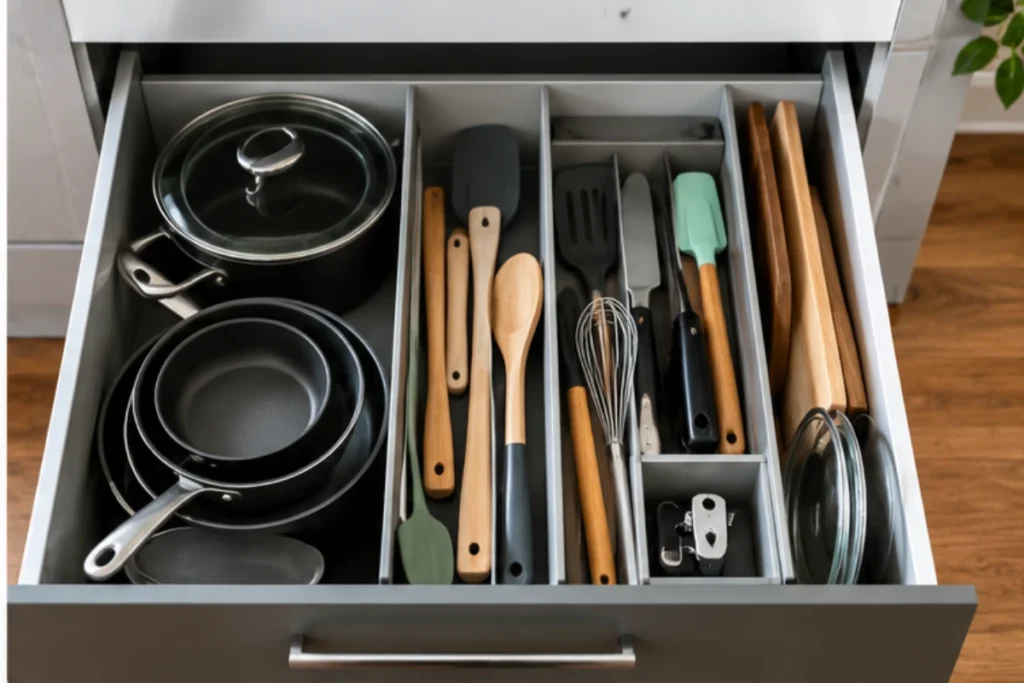
Large pull-out drawers provide plenty of storage, but their size can make them difficult to organize.
Instead of allowing everything to move freely, divide the drawer into functional sections.
For example:
-
Cooking utensils
-
Food preparation tools
-
Baking supplies
-
Small appliances or accessories
Long dividers, bins, or containers can help prevent larger items from spreading across the entire drawer.
For anyone learning how to organize kitchen drawers, large pull-out drawers are easiest to manage when similar items stay together.
For pull-out drawers, make sure organizers stay stable when the drawer is opened and closed.
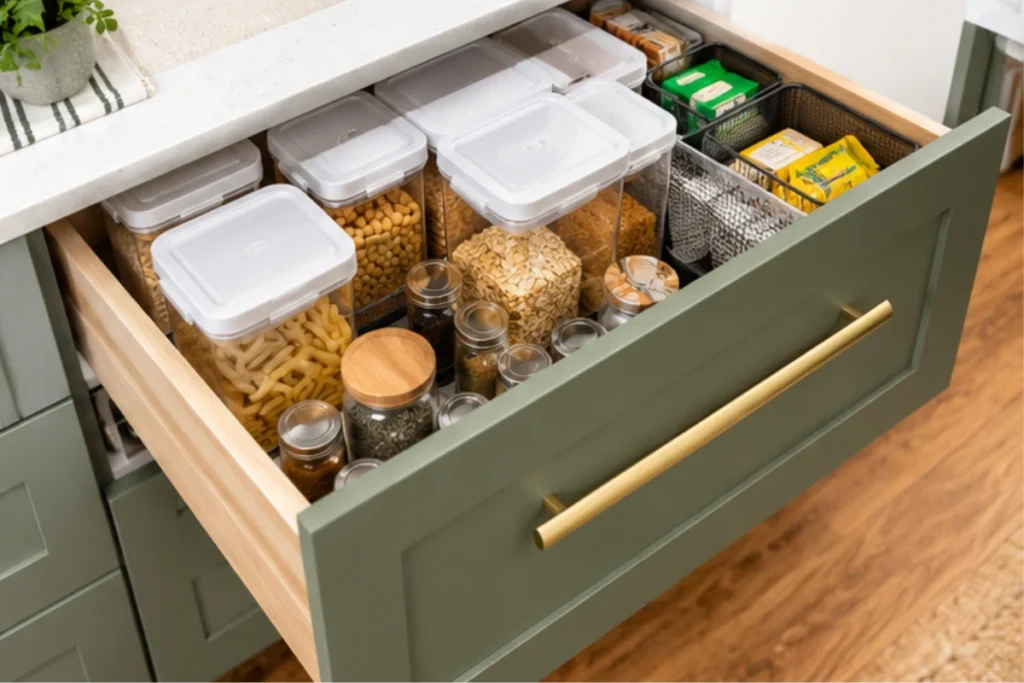
13. Use Vertical Storage for Long Kitchen Tools
Some kitchen tools don’t fit neatly into traditional horizontal compartments.
Long items such as:
-
Tongs
-
Spatulas
-
Whisks
-
Wooden spoons
-
Serving utensils
can be difficult to organize in shallow trays.
Use longer compartments or adjustable dividers to create dedicated sections.
The important thing is to avoid placing long tools diagonally across the entire drawer. A better layout keeps them contained within a specific zone.
14. Remove Duplicate and Rarely Used Kitchen Tools
Sometimes the biggest kitchen-drawer problem isn’t the organization system—it’s having too many things.
Before buying organizers, check for:
-
Duplicate utensils
-
Broken tools
-
Items you never use
-
Gadgets you forgot you owned
-
Tools that belong somewhere else
If you have several tools that perform the same job, keep the one that works best for your kitchen routine.
Decluttering first gives your drawer organizers more room to work.
15. Label Drawer Zones If It Helps Your Household
Labels aren’t necessary for every kitchen, but they can be useful when several people share the space.
For example, you could label sections:
-
Cooking
-
Baking
-
Measuring
-
Serving
-
Gadgets
This is especially useful if family members frequently put things back in the wrong place.
Keep labels simple and only use them where they genuinely make the system easier to maintain.
How to Organize Kitchen Drawers and Cabinets Together
Kitchen drawers and cabinets don’t have to work as completely separate storage systems.
Knowing how to organize kitchen drawers and cabinets together helps prevent the same type of items from being scattered across different storage areas.
Think of them as one connected organization system.
For example, you might keep everyday utensils in drawers while storing larger cookware in nearby cabinets.
A simple setup could look like this:
| Storage Area | Best For |
|---|---|
| Top drawers | Everyday utensils and small tools |
| Deep drawers | Larger cooking tools and containers |
| Lower cabinets | Pots, pans, and larger cookware |
| Pantry | Food and bulk supplies |
| Countertop | Frequently used appliances |
The exact arrangement depends on your kitchen layout, but keeping related items close together can make the entire space easier to use.
How to Organize Deep Kitchen Drawers Without Losing Space
Deep drawers are useful, but they need a different approach from shallow utensil drawers.
Avoid creating tall piles of items because the bottom of the drawer can quickly become difficult to access.
Instead:
-
Use adjustable dividers.
-
Create clear zones.
-
Keep frequently used items toward the front.
-
Store similar tools together.
-
Use containers for small loose items.
-
Avoid filling the drawer completely.
Leave a little breathing room between categories. A drawer that is slightly less full is often much easier to use.
How to Organize Small Kitchen Drawers
For a small drawer, start with the question: What do I actually need to access from here?
Choose one clear purpose rather than trying to store everything.
A small drawer might be dedicated to measuring tools, cooking utensils, or small gadgets.
Use compact organizers and avoid oversized trays with compartments you don’t need.
The goal is not maximum capacity. The goal is easy access with minimal clutter.
How to Keep Kitchen Drawers Organized
Getting an organized drawer is only half the job. The system also needs to be easy enough to maintain.
Once you understand how to organize kitchen drawers, the next step is keeping the system simple enough to maintain every day.
Try these simple habits:
Put items back in the same zone
Every item should have a predictable home.
Don’t let one drawer become a catch-all
If something doesn’t belong there, return it to its proper storage area.
Review drawers occasionally
Every few months, remove items you no longer use.
Don’t overfill organizers
If a section becomes difficult to use, it may contain too many items.
Adjust the system when your needs change
A drawer organization system doesn’t have to remain exactly the same forever.
What to Avoid When Organizing Kitchen Drawers
A few common mistakes can make an organized drawer difficult to maintain.
Buying organizers before measuring
Always measure the drawer first. An organizer that is slightly too large may be useless.
Using too many compartments
More compartments don’t automatically mean better organization.
Stacking too many items
If you have to move five things to reach one utensil, the drawer isn’t functioning efficiently.
Keeping rarely used items in prime storage
Give your easiest-to-reach drawer space to the things you use most.
Organizing by appearance alone
A drawer may look beautiful in a photo but still be inconvenient for everyday cooking. Prioritize function over appearance.
How to Choose Kitchen Drawer Organizers
If you’re considering drawer organizers, focus on the actual dimensions and contents of your drawers.
Look for:
-
Adjustable dividers
-
Non-slip bases
-
Easy-to-clean materials
-
Appropriate height
-
Compartments that match your utensils
-
Designs that allow easy access
For a small drawer, compact adjustable dividers may be more useful than a large multi-section tray.
For a deep drawer, longer dividers or stable containers may work better.
You don’t need the same organizer in every drawer. Different drawers can have different systems based on what they hold.
A Simple Kitchen Drawer Organization System
If you’re starting from scratch, this simple system can help:
Drawer 1: Everyday utensils
Drawer 2: Cooking tools
Drawer 3: Measuring and baking tools
Drawer 4: Small kitchen gadgets
Deep drawer: Larger utensils and less frequently used tools
You can adjust this layout based on your kitchen, but the basic principle is the same: give each category a home.
Frequently Asked Questions About Organizing Kitchen Drawers
How do I organize kitchen drawers?
Start by emptying the drawer, removing unused items, grouping similar tools, measuring the space, and creating dedicated zones. Store frequently used items where they are easiest to reach.
How do I organize kitchen cabinets and drawers?
Use drawers for smaller, frequently used tools and cabinets for larger cookware, appliances, and containers. Keep related categories close together so the entire kitchen works as one storage system.
How do I organize deep kitchen drawers?
Divide the drawer into zones using adjustable dividers or stable containers. Keep frequently used items toward the front and avoid stacking items so deeply that they become difficult to reach.
How do I organize small kitchen drawers?
Give the drawer one specific purpose and use a compact organizer that fits its dimensions. Prioritize frequently used items and remove duplicates or rarely used tools.
How do I organize kitchen utensils in drawers?
Group utensils by type or function, such as everyday cutlery, cooking tools, measuring tools, and serving utensils. Use dividers to keep each category contained.
How do I organize large kitchen drawers?
Divide large drawers into functional zones using long dividers, bins, or containers. Keep similar items together and make sure organizers remain stable when the drawer opens.
How do I organize pull-out kitchen drawers?
Use stable dividers or containers to prevent items from shifting as the drawer moves. Divide the space according to function and keep frequently used items easy to reach.
How often should I reorganize kitchen drawers?
A quick review every few months is usually enough. You may need to reorganize sooner if the drawer becomes difficult to use or starts collecting items that don’t belong there.
What is the best way to organize a kitchen without drawers?
Use cabinet shelves, stackable bins, baskets, shelf risers, and countertop storage to create separate zones. Keep frequently used items in the easiest-to-access areas.
Should kitchen drawers be organized by item or by function?
Either approach can work, but organizing by function is often more practical. Keeping related tools together makes them easier to find when you’re cooking or preparing food.
Related Small Kitchen Organization Guides
If you are working on a small kitchen, these GRAPCY Hub guides can help you organize other storage areas:
- 15 Small Kitchen Organization Ideas That Actually Work
- 10 Spice Rack Ideas for Small Kitchens and Better Organization
- 12 Kitchen Cabinet Organization Ideas for Small Spaces
- 15 Small Kitchen Storage Ideas to Maximize Every Inch
- 15 Small Kitchen Countertop Organization Ideas
- 12 Small Pantry Organization Ideas for Better Storage
Final Thoughts
Learning how to organize kitchen drawers doesn’t require an expensive kitchen makeover. The biggest improvement usually comes from giving every category a clear place and removing the items you don’t actually need.
Start with one drawer, empty it completely, group similar items, and measure the available space before choosing organizers. Then create simple zones based on how you use your kitchen.
Whether you’re dealing with a small utensil drawer, a deep cooking-tool drawer, or a large pull-out drawer, the best organization system is one that makes everyday items easy to find, easy to use, and easy to put away.
A well-organized drawer should make your kitchen routine simpler—not give you another complicated system to maintain.
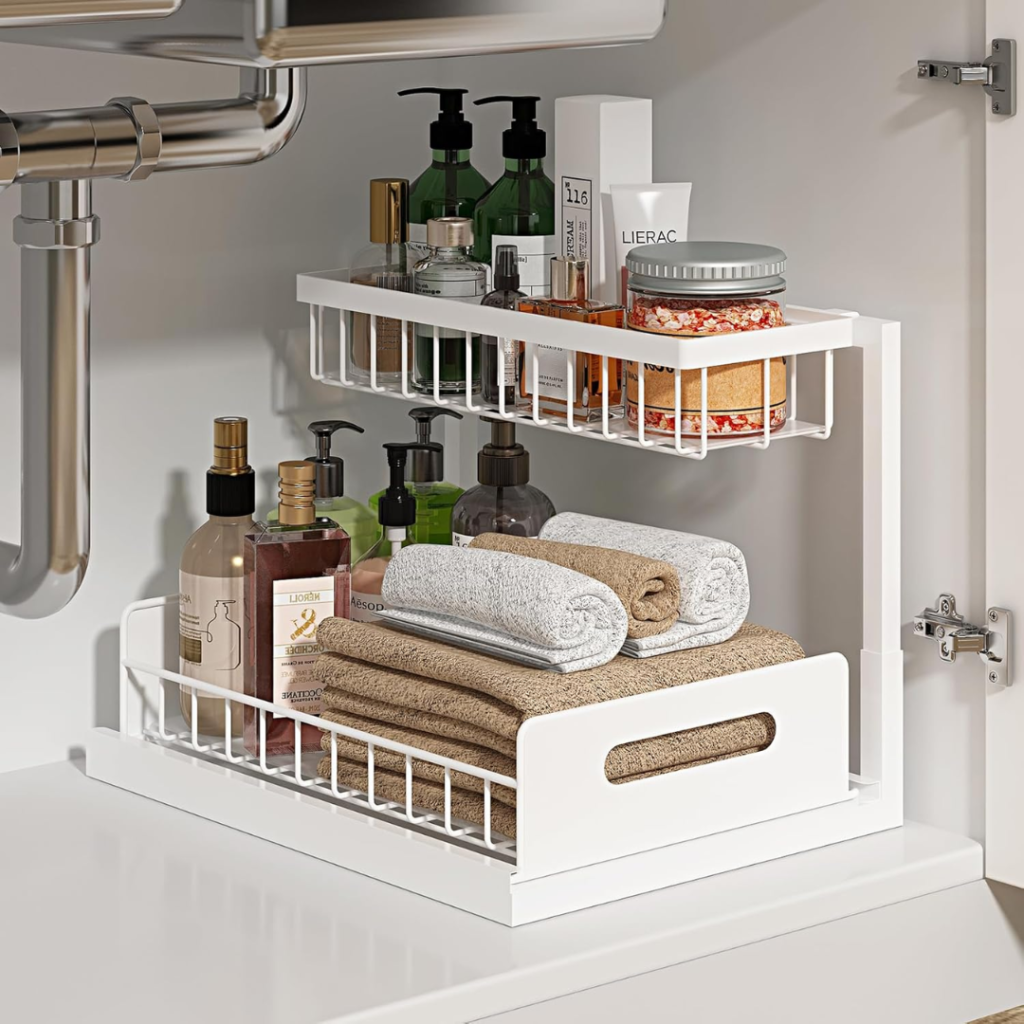
Sink Organizer
Key Features:
- L-Shaped 2-Tier Design – Makes use of vertical space while leaving room for plumbing and taller bottles.
- Pull-Out Drawer – Slides out from either side for easier access to items at the back.
- Tool-Free Installation – Includes suction cups and adhesive for stable placement without drilling.
- Sturdy & Rust-Resistant – Steel construction with a water-friendly grid design and removable pads.
- Versatile Storage – Great for under-sink cabinets, kitchens, bathrooms, and laundry areas.
- Size: 14.2 × 10.6 × 11 inches; bottom tier fits bottles up to 8 inches tall.
As an Amazon Associate I earn from qualifying purchases.