
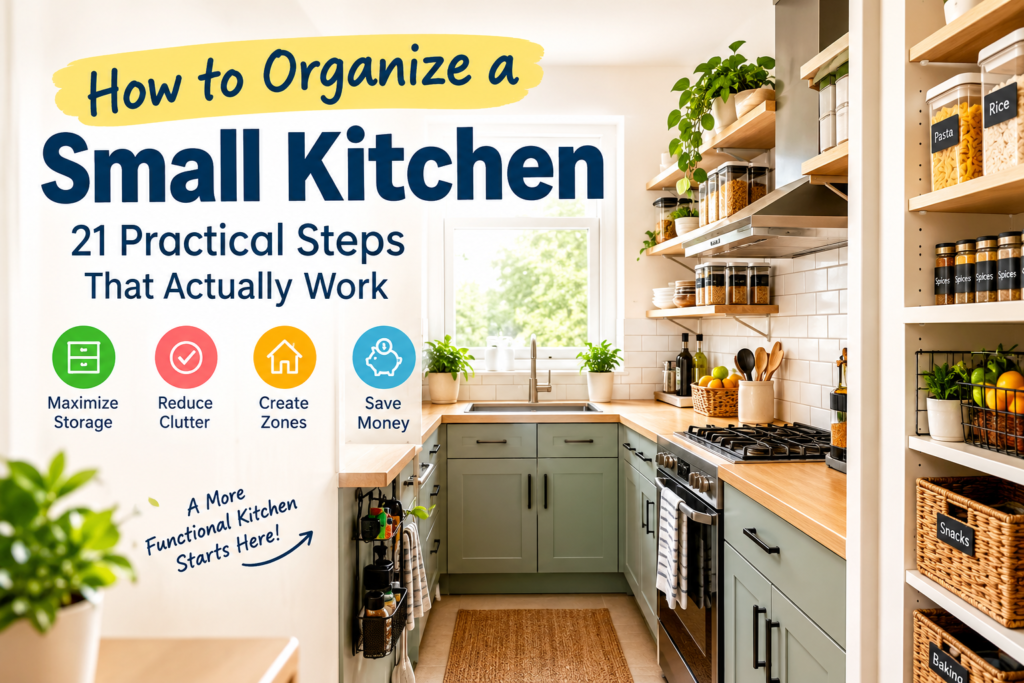
A small kitchen can feel crowded even when you don’t own that many things. Limited cabinets, narrow counters, awkward corners, and appliances competing for space can quickly turn everyday cooking into a frustrating task.
The good news is that you usually don’t need a bigger kitchen to make the space work better. You need a better system for deciding what stays, where it goes, and how often you use it.
In this guide, you’ll learn how to organize a small kitchen step by step, including practical solutions for kitchens with few cabinets, no pantry, limited drawers, or very little counter space.
| What to Do | Main Benefit |
|---|---|
| Declutter unused items | Creates immediate space |
| Group similar items | Makes everything easier to find |
| Prioritize everyday items | Keeps frequently used items accessible |
| Create kitchen zones | Makes cooking more efficient |
| Organize cabinets by function | Prevents wasted cabinet space |
| Use vertical cabinet space | Stores more without adding cabinets |
| Control countertop clutter | Creates more usable prep space |
| Create a pantry zone | Keeps food organized without a full pantry |
| Organize spices | Makes cooking faster |
| Improve drawer storage | Prevents messy drawers |
| Use awkward corners | Turns dead space into storage |
| Organize under the sink | Makes cleaning supplies easier to manage |
| Store appliances strategically | Frees valuable counter space |
| Use wall space | Adds storage without using floor space |
| Organize with few cabinets | Makes limited storage work harder |
| Organize without a pantry | Creates practical food-storage zones |
| Organize without drawers | Uses alternative storage solutions |
| Make an apartment kitchen work | Adapts storage to a smaller footprint |
| Organize on a budget | Improves storage without major spending |
| Keep counters functional | Makes everyday cooking easier |
| Create a maintenance routine | Keeps the kitchen organized long-term |
Quick Overview: How to Organize a Small Kitchen
1. Start by Removing Things You Don't Actually Use
Before buying organizers, start with what you already own.
Small kitchens become difficult to manage when every cabinet, drawer, and shelf is filled with items that are rarely used.
Take everything out of one storage area at a time and sort it into four groups:
- Keep and use regularly
- Keep but use occasionally
- Donate or give away
- Recycle or discard
Look especially closely at duplicate utensils, damaged containers, unused gadgets, expired food, and appliances you haven’t used in months.
Why this matters: organizing unnecessary items only creates a more attractive version of the same storage problem.
A simple rule
If you have not used something in a long time and it does not serve a specific purpose, ask yourself whether it deserves valuable space in a small kitchen.
Don’t automatically throw away useful items just because they’re not used every day. The goal is to remove unnecessary clutter, not to own as little as possible.
2. Group Similar Items Together
Once you’ve decluttered, group similar items before deciding where they should go.
For example:
- Baking supplies together
- Coffee and tea together
- Cooking utensils together
- Food storage containers together
- Spices together
- Cleaning supplies together
- Everyday dishes together
- Small appliances together
This creates a predictable system.
Instead of searching through several cabinets for one item, you’ll know which area to check first.
Try the “same job, same zone” rule
Items that are normally used together should be stored close to each other whenever possible.
For example, keep measuring cups near baking ingredients and cooking utensils near the stove.
This makes your kitchen easier to use without requiring additional storage.
3. Give Prime Space to the Things You Use Every Day
Not every kitchen item deserves equally convenient storage.
Your most frequently used items should be stored in the easiest-to-reach locations.
Keep everyday items such as:
- Plates
- Drinking glasses
- Coffee mugs
- Cooking utensils
- Frequently used pans
- Everyday food ingredients
within easy reach.
Less frequently used serving dishes, specialty appliances, and seasonal items can go into higher cabinets or less convenient storage areas.
The goal isn’t just to fit everything. It’s to make the kitchen work efficiently.
4. Create Simple Kitchen Zones
One of the easiest ways to organize a small kitchen is to divide it into functional zones.
You don’t need a huge kitchen for this approach.
You might create:
Prep zone: cutting boards, knives, mixing bowls, and frequently used ingredients.
Cooking zone: pots, pans, cooking utensils, oils, and spices.
Coffee zone: coffee maker, mugs, coffee, filters, and sweeteners.
Cleaning zone: dish soap, sponges, towels, and cleaning products.
Food-storage zone: pantry items, containers, wraps, and bags.
When related items stay together, you spend less time walking around the kitchen looking for things.
5. Organize Cabinets by Function
Instead of putting items wherever there happens to be empty space, give each cabinet a specific purpose.
For example:
- One cabinet for everyday dishes
- One for glasses and mugs
- One for cookware
- One for food storage
- One for baking supplies
You can adjust the system according to your kitchen layout.
Cabinet organization tip
Store the things you use most often between eye level and waist level whenever possible.
Reserve higher or harder-to-reach shelves for items you use less frequently.
This small change can make a surprisingly big difference in a compact kitchen.
6. Use Vertical Space Inside Cabinets
One common small-kitchen problem is unused vertical space.
A cabinet shelf may have enough room for several plates or bowls stacked on top of each other, but the space above them can remain completely empty.
Shelf risers can divide that unused height into additional storage levels.
They can be useful for:
- Plates
- Bowls
- Mugs
- Small serving dishes
- Food containers
Pros and cons of shelf risers
| Pros | Cons |
|---|---|
| Uses unused vertical space | Not ideal for every cabinet |
| Inexpensive option | Can become cluttered if overloaded |
| Easy to install | Some low-quality versions may feel unstable |
| Makes items easier to access | Takes up some shelf surface area |
Measure your cabinet before buying anything so the organizer actually fits.
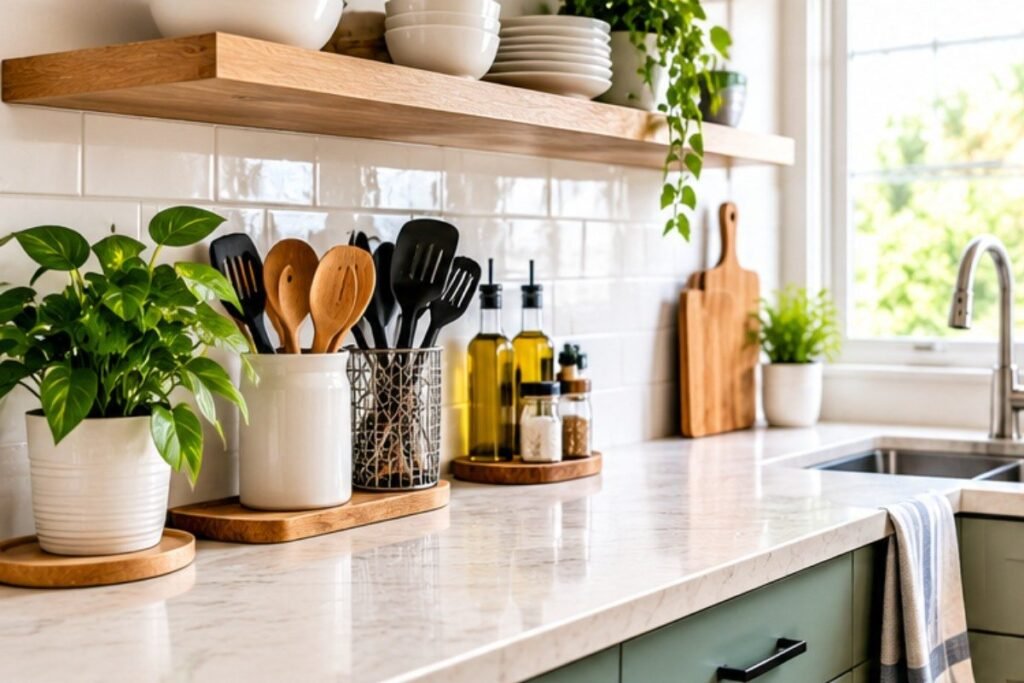
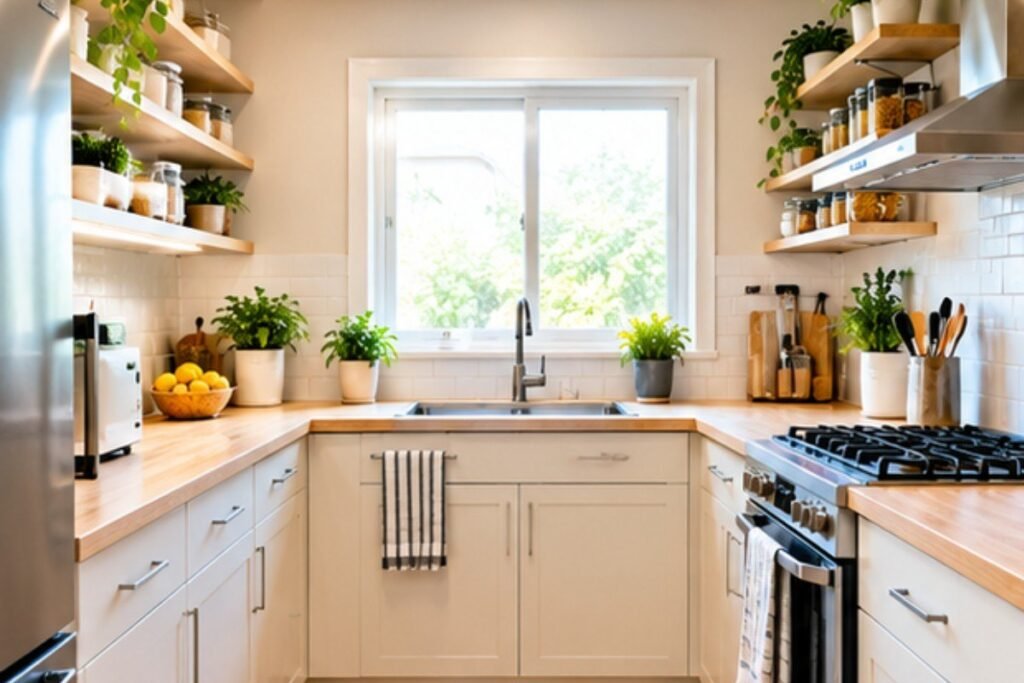
7. Keep Countertops as Clear as Possible
Counter space is one of the most valuable resources in a small kitchen.
Instead of treating the countertop as permanent storage, decide which items genuinely deserve to stay there.
A good rule is:
If you use it almost every day, countertop storage may make sense. If you rarely use it, find another home.
Keep only practical everyday items such as a coffee maker, toaster, or frequently used cooking tools if they fit your routine.
Everything else should have a designated storage location.
This creates more room for food preparation and makes the entire kitchen look less crowded.
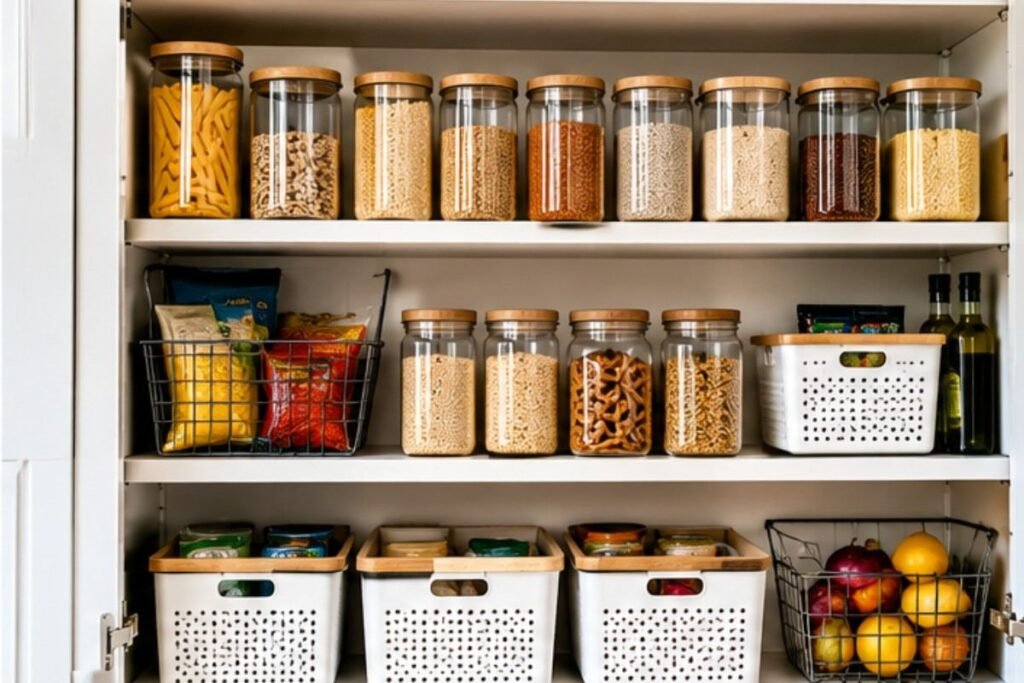
8. Create a Pantry Zone Even If You Don't Have a Pantry
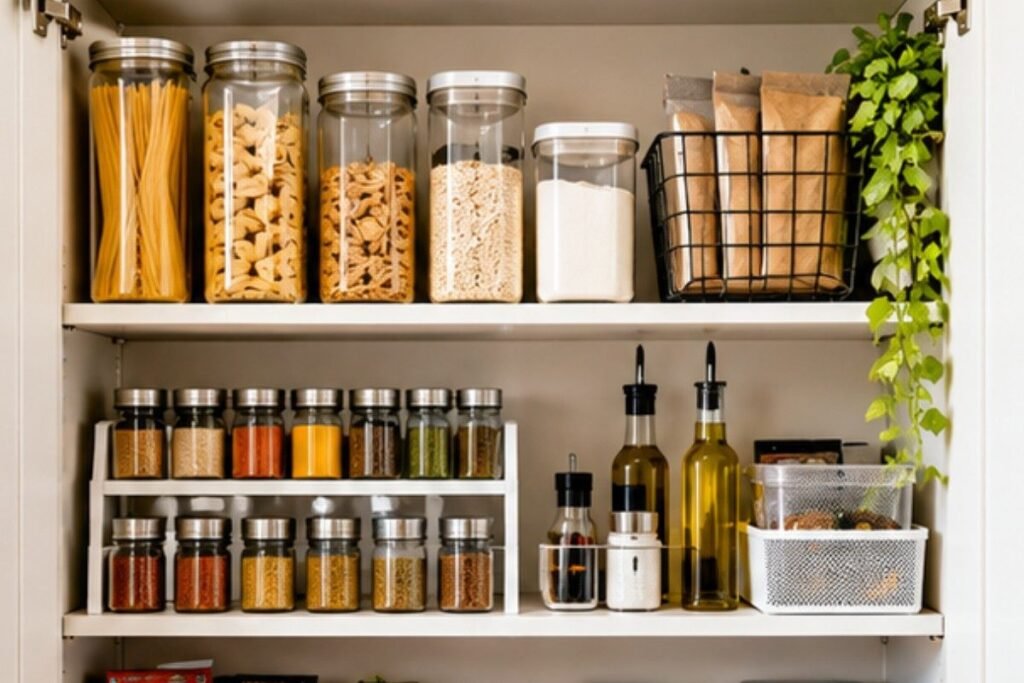
You don’t need a dedicated pantry to organize food effectively.
If your kitchen doesn’t have a pantry, designate one cabinet, shelf, rolling cart, or narrow storage area for dry goods.
Group items such as:
- Pasta
- Rice
- Cereal
- Canned foods
- Baking ingredients
- Snacks
- Breakfast foods
Use containers only where they genuinely improve visibility or organization. You don’t need to transfer every food item into matching containers.
Small pantry organization tip
Keep frequently used food at eye level and less frequently used items higher or farther back.
This reduces the need to move everything around whenever you need one ingredient.
9. Organize Spices Around How You Actually Cook
Spices can quickly become difficult to manage because small containers are easy to stack, hide, and forget.
Choose a storage method based on your available space.
Options include:
- A narrow spice rack
- A cabinet shelf riser
- A drawer organizer
- A pull-out spice rack
- Magnetic spice storage
Arrange spices so the labels are visible.
You can also group them by frequency of use rather than alphabetically. For example, everyday cooking spices can stay in the most accessible position while specialty spices can be stored farther away.
For more ideas, see our guide to spice rack ideas for small kitchens and better organization.
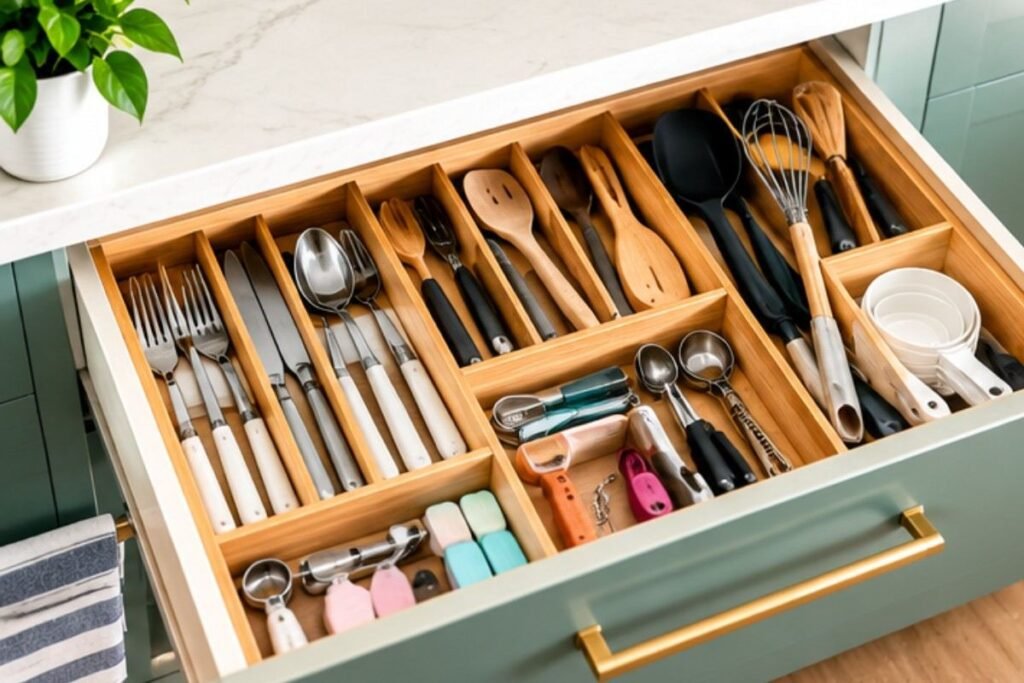
10. Make Kitchen Drawers Easier to Use
Drawers can provide excellent storage in a small kitchen, but only when their contents are controlled.
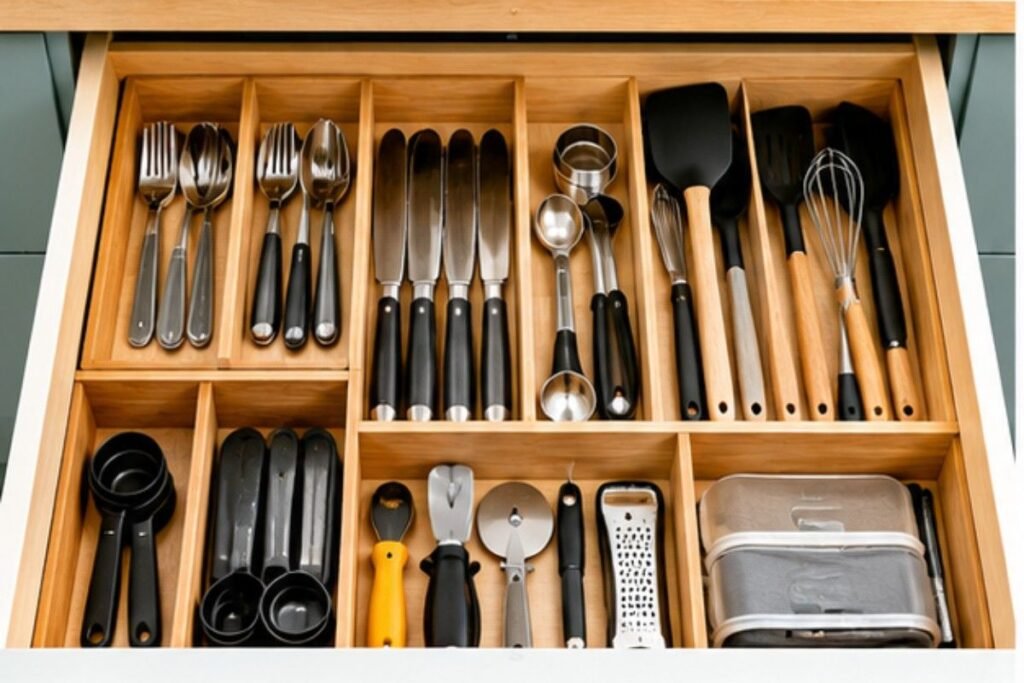
Start by removing everything from the drawer and grouping similar items.
Then use dividers or small organizers for categories such as:
- Cutlery
- Measuring tools
- Cooking utensils
- Kitchen gadgets
- Food-storage accessories
Avoid filling every inch simply because there is space.
A drawer that contains fewer items but allows you to see everything clearly is much more useful than a drawer packed from front to back.
11. Turn Awkward Corners Into Useful Storage
Small kitchens often contain awkward areas that are difficult to use.
Instead of ignoring them, look for storage opportunities around:
- Corners
- Narrow gaps
- Spaces beside appliances
- Empty wall sections
- Areas above cabinets
- Space underneath the sink
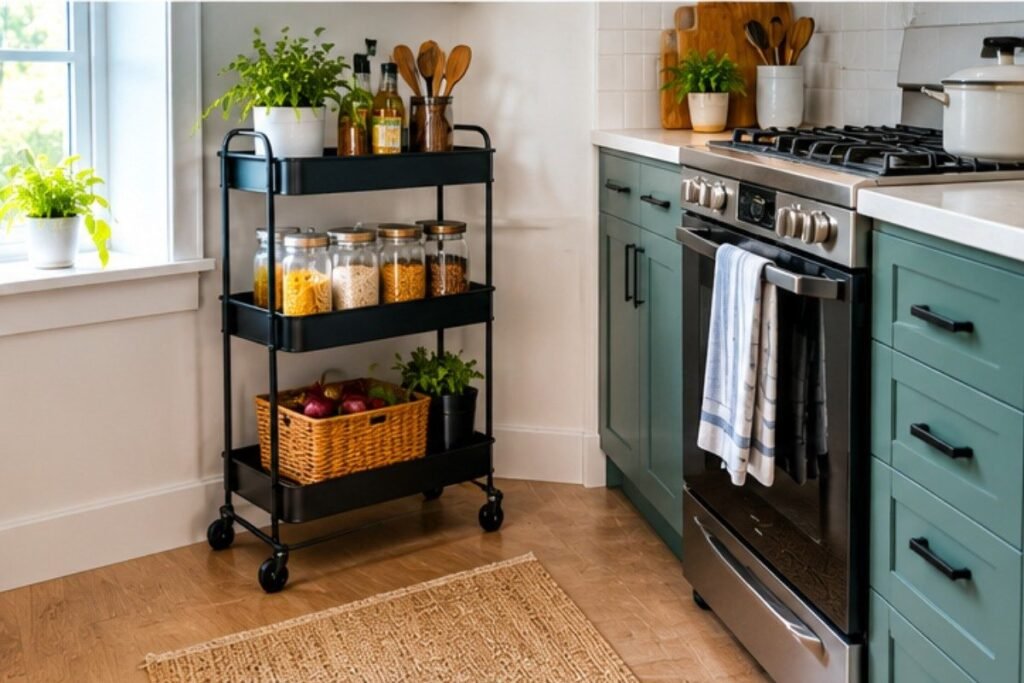
A slim rolling cart can sometimes fit into a narrow gap and provide useful storage for spices, oils, cleaning products, or pantry items.
The key is to measure the space first rather than buying an organizer and hoping it fits.
12. Organize the Space Under the Sink
The cabinet beneath the kitchen sink is often one of the least organized areas in the home.
Pipes make the space awkward, and cleaning supplies can quickly become difficult to find.
Use compact bins or stackable organizers to separate categories.
For example:
Bin 1: Dishwashing supplies
Bin 2: Cleaning sprays
Bin 3: Sponges, brushes, and gloves
Keep frequently used products toward the front.
Also avoid storing unrelated items under the sink simply because there is empty space. Keeping this area dedicated to cleaning supplies makes it easier to maintain.
13. Store Appliances According to Frequency of Use
Small appliances can consume a surprising amount of space.
Instead of keeping every appliance on the counter, divide them into three categories:
Daily use: Keep accessible.
Weekly use: Store nearby but out of the way.
Occasional use: Store in a cabinet, closet, or another suitable location.
For example, if you use a blender several times a week, it may deserve easier access than an appliance used only once or twice a year.
This simple priority system can free up valuable counter space.
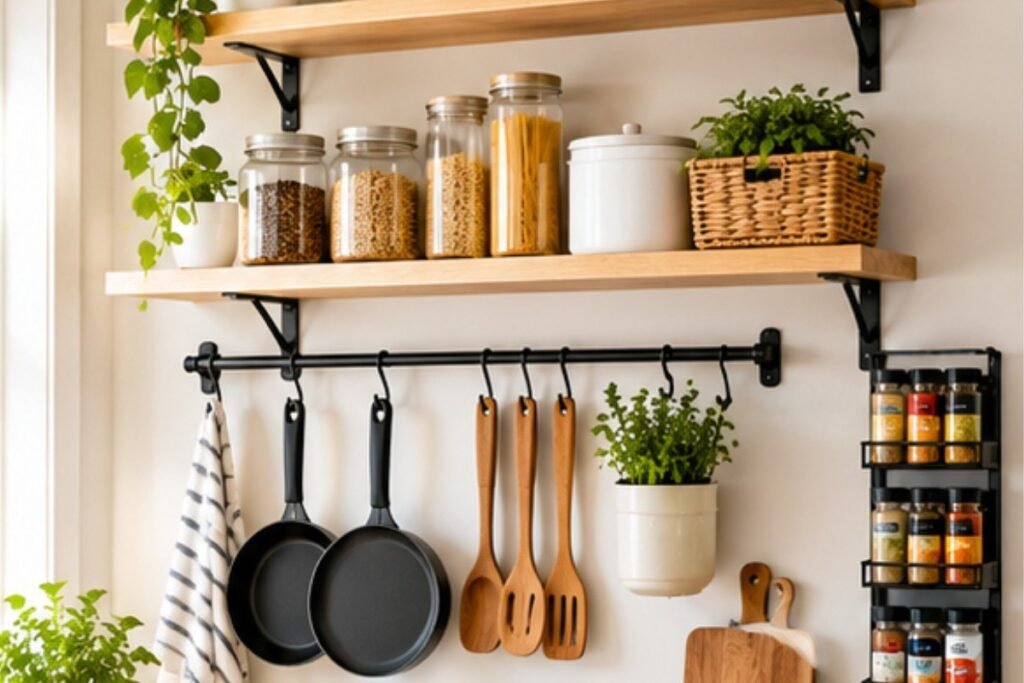
14. Use Empty Wall Space
When floor and cabinet space are limited, look upward.
An empty wall can sometimes provide storage for lightweight kitchen items.
Depending on your space and rental restrictions, you could consider:
- Wall-mounted shelves
- Hooks
- Hanging rails
- Magnetic storage
- Small organizers
Use wall storage carefully. Too many visible items can make a small kitchen look busier rather than more organized.
Choose a few items that are practical and easy to access.
15. How to Organize a Small Kitchen With Few Cabinets
If your kitchen has only a few cabinets, don’t try to store everything inside them.
Instead, divide storage between several types of spaces.
For example:
- Cabinets for everyday dishes and cookware
- A rolling cart for pantry items
- Wall storage for frequently used tools
- A drawer for utensils
- Under-sink storage for cleaning supplies
- A designated shelf for small appliances
The goal is to make every storage area serve a specific purpose.
A useful priority system
When cabinet space is limited, prioritize:
- Everyday essentials
- Cooking equipment
- Frequently used food
- Cleaning supplies
- Occasionally used items
- Specialty or seasonal items
This prevents rarely used items from taking the best storage locations.
16. How to Organize a Small Kitchen Without a Pantry
No pantry doesn’t mean no food-storage system.
Choose one or two areas to function as your pantry.
A cabinet, shelf, narrow rolling cart, or suitable freestanding organizer can work depending on your layout.
Keep food categories together and avoid creating multiple mini-pantries throughout the kitchen.
For example, storing cereal in one cabinet, pasta in another, and snacks somewhere else may make the kitchen harder to manage.
One clearly defined food-storage zone is usually easier to maintain.
17. How to Organize a Small Kitchen Without Drawers
If your kitchen has few or no drawers, you can still create functional storage.
Consider using:
- Small bins inside cabinets
- Countertop utensil containers
- Shelf risers
- Hanging hooks
- Door-mounted organizers
- Divided containers
- Small baskets
For utensils, a countertop holder can be more practical than trying to force everything into a cabinet.
The important thing is to create categories so similar items remain together.
18. Make an Apartment Kitchen Work Better
Apartment kitchens often have limited storage, little counter space, and layouts that cannot be permanently modified.
Focus on flexible solutions that don’t require major renovation.
Good options can include:
- Freestanding carts
- Removable organizers
- Shelf risers
- Storage bins
- Tension-style solutions where appropriate
- Temporary hooks where permitted
- Over-the-door storage
Before adding anything, check your lease and avoid modifications that could damage the property.
Apartment kitchen rule
Choose storage that can serve more than one purpose.
For example, a slim rolling cart can provide pantry storage while also giving you an extra surface when needed.
19. Organize a Small Kitchen on a Budget
You don’t need to spend hundreds of dollars to improve a small kitchen.
Start with free changes first.
Free or low-cost improvements
- Remove unused items
- Rearrange cabinet contents
- Group similar items
- Move rarely used items to higher shelves
- Clear unnecessary countertop items
- Create functional zones
- Use existing containers more efficiently
Then consider inexpensive organizers only where they solve a specific problem.
Don’t buy an organizer simply because it looks useful.
First identify the problem, measure the space, and decide what the organizer needs to accomplish.
This prevents you from spending money on products that eventually become clutter themselves.
20. Create a Functional Countertop System
Once you’ve organized your cabinets and storage areas, take another look at your countertops.
Ask yourself:
- What do I use every day?
- What is only taking up space?
- Which appliances could be stored elsewhere?
- Where do food-preparation tasks usually happen?
- Is there enough open space to comfortably prepare food?
Try to keep at least one clear preparation area whenever possible.
A small kitchen becomes much easier to use when you don’t have to move five things before you can start preparing a meal.
21. Create a Simple Maintenance Routine
The final step is often overlooked.
Even the best kitchen organization system will eventually become messy if there is no maintenance routine.
You don’t need to reorganize the entire kitchen every week.
Instead, spend a few minutes resetting the space.
A simple weekly reset
1. Return items to their designated zones.
2. Remove food that has expired or is no longer usable.
3. Clear unnecessary countertop items.
4. Check whether drawers and cabinets are becoming overcrowded.
5. Put newly purchased items in their proper category.
6. Move frequently used items back to accessible locations.
This small habit prevents clutter from gradually taking over again.
Common Small Kitchen Organization Mistakes to Avoid
Even well-intentioned organization efforts can make a kitchen less practical.
Buying organizers before decluttering
An organizer cannot solve the problem of owning too many things.
Declutter first.
Filling every empty space
Empty space isn’t necessarily wasted space.
Leaving some breathing room makes cabinets easier to use and maintain.
Keeping everything on the counter
Visible storage can be convenient, but too much of it quickly makes a small kitchen feel crowded.
Ignoring vertical space
If you’re only using the bottom half of a cabinet or wall, you’re leaving potential storage unused.
Organizing by appearance instead of function
A perfectly matching kitchen may look attractive but still be frustrating to use.
Prioritize accessibility and your actual cooking habits.
Buying products without measuring
Always measure the width, depth, and height of the area before purchasing storage products.
How to Know Where Everything Should Go
When you’re unsure where to store an item, ask these three questions:
How often do I use it?
Frequently used items should be easy to reach.
What other items do I use it with?
Store related items together whenever possible.
How much space does it actually need?
Don’t give a large storage area to a small collection of items if that space could be used more efficiently.
This simple decision process can help you organize almost any small kitchen.
Small Kitchen Organization: What to Prioritize First
If your kitchen feels completely overwhelmed, don’t try to fix everything in one afternoon.
Start with the areas that will make the biggest difference.
| Priority | Area | Why It Matters |
|---|---|---|
| 1 | Countertops | Immediately creates usable workspace |
| 2 | Everyday cabinets | Improves daily accessibility |
| 3 | Food storage | Prevents duplicate and forgotten items |
| 4 | Drawers | Reduces small-item clutter |
| 5 | Under the sink | Controls cleaning-supply mess |
| 6 | Appliances | Frees valuable counter space |
| 7 | Less-used storage | Handles occasional items |
This approach gives you visible progress without making the project overwhelming.
Frequently Asked Questions
What is the best way to organize a very small kitchen?
Start by decluttering, then group similar items and create functional zones. Give the easiest-to-reach storage to everyday essentials and use vertical, wall, and overlooked spaces for additional storage.
How do I organize a small kitchen with very little cabinet space?
Prioritize everyday items inside your cabinets and use other suitable areas for storage, such as a rolling cart, wall-mounted storage, shelf risers, or designated pantry shelves.
How do I organize a small kitchen without a pantry?
Choose one cabinet, shelf, cart, or suitable storage area to function as your pantry. Group dry goods together and keep frequently used foods in the easiest-to-reach locations.
How do I organize a small kitchen without cabinets?
Use a combination of freestanding storage, rolling carts, shelves, hooks, countertop organizers, and other appropriate solutions. Focus on creating specific zones rather than trying to replicate a traditional cabinet layout.
How can I organize a small kitchen on a budget?
Start with free solutions such as decluttering, rearranging cabinets, grouping items, and clearing countertops. Only purchase organizers after identifying a specific storage problem.
How do I organize a small kitchen without drawers?
Use cabinet bins, shelf risers, countertop utensil holders, hooks, and other suitable organizers to create separate categories for small kitchen tools.
How can I get more counter space in a small kitchen?
Remove rarely used items from the countertop and relocate appliances that don’t need to stay out. Use vertical or alternative storage for items that are currently occupying valuable prep space.
How do I organize a small apartment kitchen?
Prioritize flexible storage such as rolling carts, removable organizers, shelf risers, and compact storage solutions. Avoid permanent modifications if you’re renting unless they are permitted.
Should I use containers to organize a small kitchen?
Containers can be helpful for specific categories, especially pantry items and small loose objects. However, you don’t need to transfer everything into containers. Use them when they make storage easier to see, access, or maintain.
How do I keep a small kitchen organized?
Give every category a designated home and perform a quick weekly reset. Returning items to their proper zones and removing unnecessary clutter regularly is easier than repeatedly reorganizing the entire kitchen.
Related Small Kitchen Organization Guides
If you are working on a small kitchen, these GRAPCY Hub guides can help you organize other storage areas:
- 15 Small Kitchen Organization Ideas That Actually Work
- 10 Spice Rack Ideas for Small Kitchens and Better Organization
- 12 Kitchen Cabinet Organization Ideas for Small Spaces
- 15 Small Kitchen Storage Ideas to Maximize Every Inch
- 15 Small Kitchen Countertop Organization Ideas
- 12 Small Pantry Organization Ideas for Better Storage
Final Thoughts
Learning how to organize a small kitchen isn’t about finding a perfect storage product for every problem. It’s about creating a system that matches the way you actually use your kitchen.
Start by removing unnecessary items, group similar things together, give prime space to everyday essentials, and use vertical and overlooked areas intelligently. Then create simple zones so everything has a logical home.
Most importantly, don’t try to maximize every inch just for the sake of storing more. A well-organized small kitchen should feel easier to use, not simply more tightly packed.
Once your basic system is working, a few carefully chosen storage solutions can make the space even more efficient without making it feel cluttered.
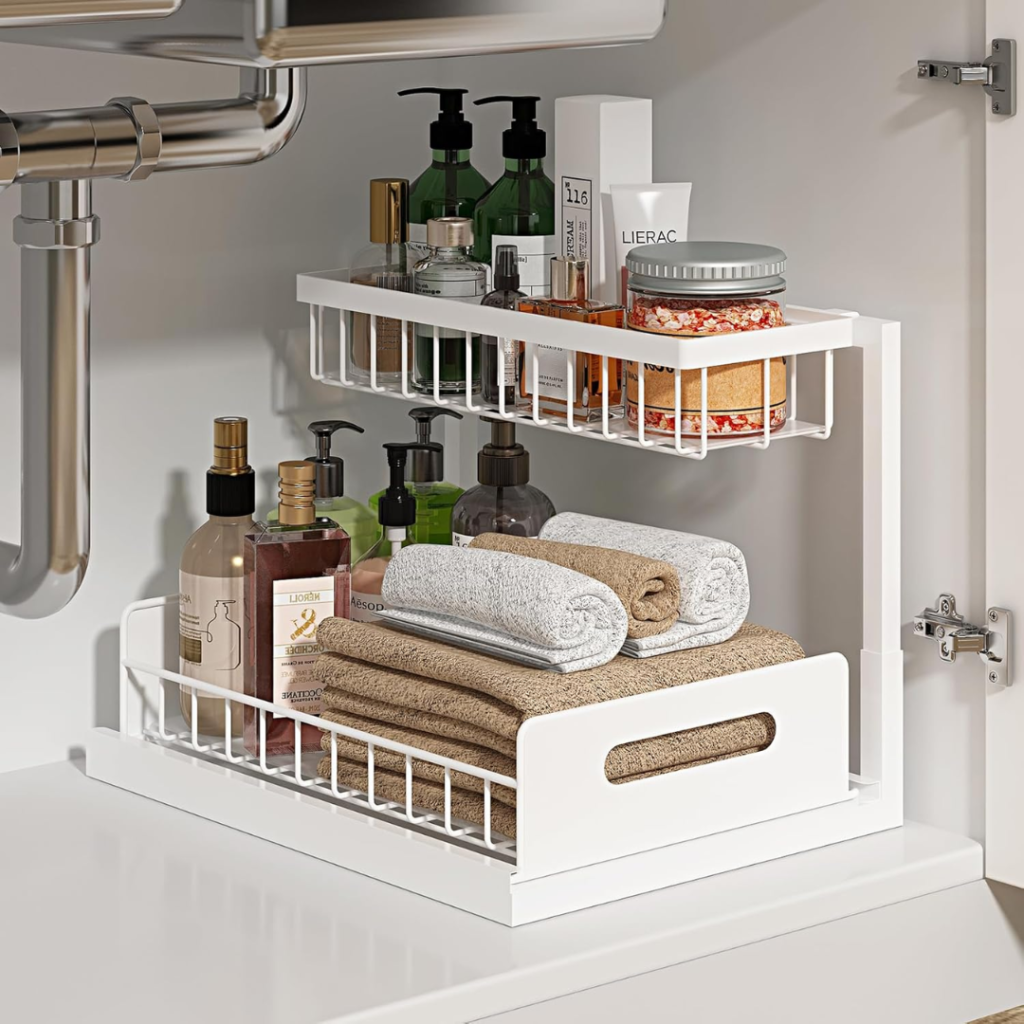
Sink Organizer
Key Features:
- L-Shaped 2-Tier Design – Makes use of vertical space while leaving room for plumbing and taller bottles.
- Pull-Out Drawer – Slides out from either side for easier access to items at the back.
- Tool-Free Installation – Includes suction cups and adhesive for stable placement without drilling.
- Sturdy & Rust-Resistant – Steel construction with a water-friendly grid design and removable pads.
- Versatile Storage – Great for under-sink cabinets, kitchens, bathrooms, and laundry areas.
- Size: 14.2 × 10.6 × 11 inches; bottom tier fits bottles up to 8 inches tall.
As an Amazon Associate I earn from qualifying purchases.