
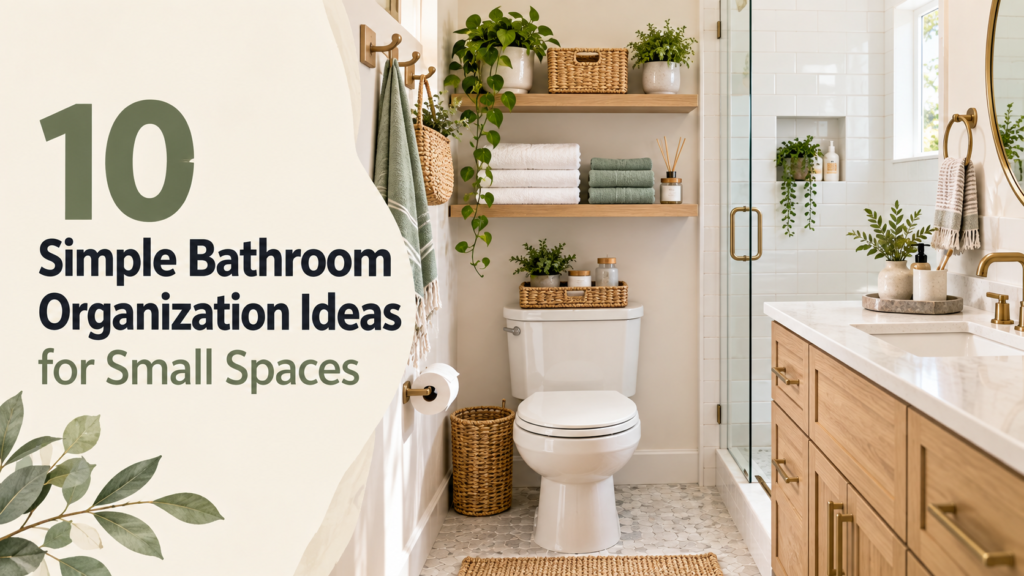
A small bathroom does not necessarily need more storage—it usually needs better use of the space you already have.
When the countertop is crowded, toiletries are scattered under the sink, and shower products have nowhere to go, even a reasonably functional bathroom can feel much smaller than it actually is.
The good news is that you can improve a compact bathroom without a major remodel. The most useful small bathroom organization ideas focus on vertical space, unused areas, defined storage zones, and organizers that make everyday items easier to reach.
From over-the-toilet storage and under-sink organizers to shower caddies and door storage, these ideas can help you create a bathroom that feels more organized without sacrificing the space you need to move around.
If you’re looking for small bathroom organization ideas, the key is to make every available space work harder.
Quick Guide: Small Bathroom Organization Ideas
| Organization idea | Best for | Space used | Installation |
|---|---|---|---|
| Over-the-toilet shelf | Towels & toiletries | Vertical | Freestanding or mounted |
| Under-sink organizer | Cleaning & personal care | Hidden | Usually no tools |
| Shower caddy | Shampoo & body wash | Shower wall/corner | Varies |
| Door organizer | Small accessories | Door | Over-door |
| Vanity drawer dividers | Makeup & grooming items | Existing drawer | No installation |
| Countertop tray | Daily essentials | Countertop | None |
| Wall shelves | Towels & decor | Wall | Usually mounting |
| Narrow rolling cart | Extra storage | Floor gap | Freestanding |
| Corner shelves | Unused corners | Vertical corner | Varies |
| Decluttered storage zones | Any bathroom | Existing space | None |
1. Use the Space Over the Toilet
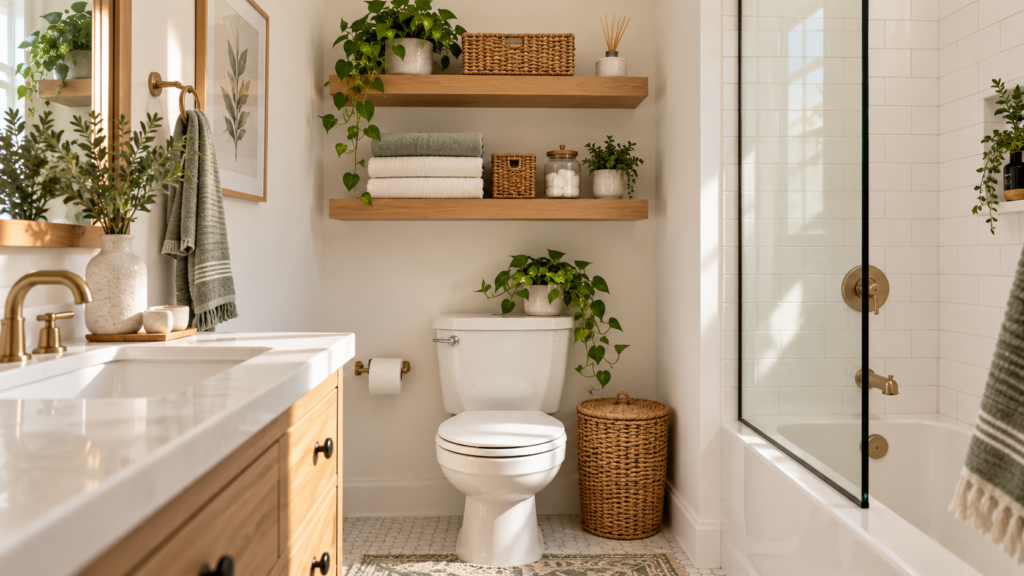
The area above the toilet is often one of the most useful vertical spaces in a small bathroom.
Instead of leaving it completely empty, consider a freestanding over-the-toilet shelf or storage unit.
You can use the shelves for:
- Extra toilet paper
- Folded hand towels
- Small baskets
- Toiletries
- Cleaning supplies
- Decorative items
Why it works
It adds storage without taking up much additional floor area.
Pros
- Uses otherwise overlooked vertical space
- Available in many sizes
- Freestanding options require little or no installation
- Useful for bathrooms with limited cabinets
Cons
- Can make a small bathroom look crowded if overloaded
- Large units may interfere with the toilet area
- Open shelves require regular tidying
Tip: Measure the space around the toilet before buying. You want enough clearance for comfortable use and cleaning.
2. Organize the Space Under the Sink
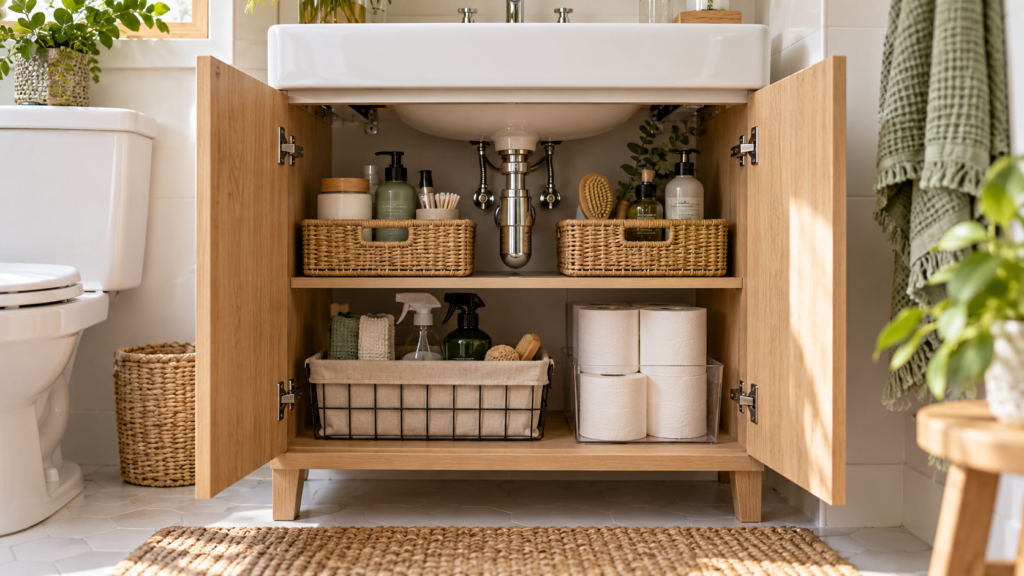
The cabinet underneath the bathroom sink can provide valuable storage, but plumbing often makes this space awkward.
Rather than placing everything directly on the cabinet floor, use stackable bins, sliding organizers, or a two-level under-sink shelf.
A useful system is to separate items into zones:
Daily use:
Skincare, hair products, dental supplies
Backup supplies:
Extra soap, shampoo, toothpaste and toilet paper
Cleaning:
Bathroom cleaners, sponges and disposable cleaning supplies
What to look for in an under-sink organizer
- Adjustable shelves
- Pull-out drawers
- Pipe clearance
- Easy-to-clean material
- Rust/moisture resistance
Pros
- Keeps clutter hidden
- Makes use of existing cabinet space
- Can dramatically improve accessibility
Cons
- Plumbing can limit the organizer size
- Some inexpensive organizers can be unstable
- Moisture can damage unsuitable materials
Measure around the plumbing first. Don’t buy an organizer based only on the cabinet’s outside dimensions.
3. Add a Compact Shower Caddy
Shower products can quickly take over a small tub or shower.
Instead of placing shampoo, conditioner, body wash and razors along the floor or edge of the tub, create one dedicated storage zone.
A shower caddy can work particularly well when it provides enough room without extending too far into the shower area.
Choose based on your shower
Showerhead caddy:
Useful when you want easy access without drilling.
Corner caddy:
Makes use of an otherwise unused corner.
Tension-pole caddy:
Can provide multiple shelves from floor to ceiling.
Adhesive/suction storage:
Useful in appropriate surfaces, but always follow the product’s installation and weight instructions.
Pros
- Keeps shower products together
- Frees the tub or shower floor
- Makes daily routines easier
Cons
- Moisture can cause rust or buildup on unsuitable materials
- Adhesive products aren’t suitable for every surface
- Overloading can cause instability
Avoid choosing a caddy based only on appearance. Capacity, drainage, material and installation method matter more in a wet environment.
4. Use the Back of the Bathroom Door
The back of a bathroom door can become useful storage without taking away valuable floor space.
An over-the-door organizer can hold lightweight items such as:
- Hair accessories
- Toiletries
- Cleaning cloths
- Small grooming tools
- Extra personal-care products
This is particularly useful when cabinet space is limited.
Pros
- Uses vertical space
- No permanent wall installation
- Easy to remove
- Good for renters
Cons
- Door clearance must be checked
- Heavy organizers can make the door harder to operate
- Too much storage can look messy
Best approach: use the door for smaller, lightweight categories rather than turning it into another clutter zone.
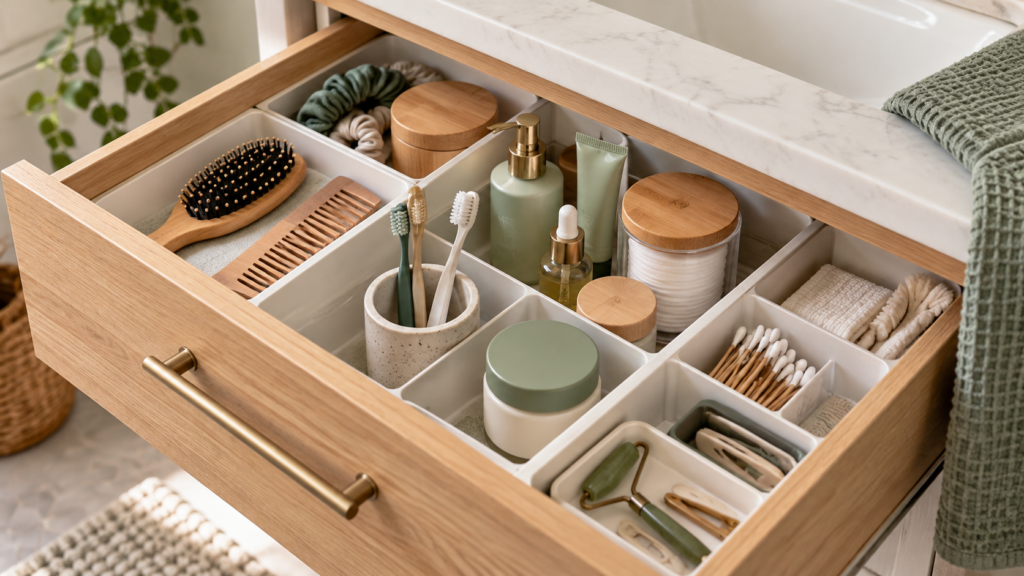
5. Divide Bathroom Drawers by Category
If you have a bathroom vanity drawer, don’t let everything become one large pile.
Use small drawer dividers or removable bins to create separate sections.
For example:
| Zone | Items |
|---|---|
| Dental | Floss, toothpaste, toothbrush accessories |
| Grooming | Clippers, combs, scissors |
| Skincare | Everyday skincare products |
| Hair | Hair ties, brushes, accessories |
| Backup | Unopened everyday essentials |
The goal isn’t to make every item perfectly arranged.
The goal is to make the item you need easy to find without searching through the entire drawer.
Pros
- Inexpensive
- Uses existing storage
- Easy to change later
Cons
- Dividers take up a small amount of drawer space
- Too many categories can become unnecessarily complicated
A small bathroom countertop can feel crowded very quickly.
Instead of keeping every product on the counter, create a small daily-use zone.
Keep only the products you regularly use.
For example:
- Hand soap
- Toothbrush holder
- One skincare tray
- Small tissue holder
- One decorative item
Everything else can go into drawers, cabinets or baskets.
A small tray can also help contain several related items in one defined area.
Why this matters
Recent design coverage has also highlighted cluttered bathroom countertops as something that can make a bathroom feel visually smaller.
Pros
- Makes the counter easier to clean
- Creates a less cluttered appearance
- Keeps daily products accessible
Cons
- Requires regular resetting
- Doesn’t create additional storage by itself
Simple rule: if you don’t use it most days, it probably doesn’t need permanent countertop space.
7. Add a Narrow Rolling Storage Cart
A slim rolling cart can be useful when you have a small unused gap beside a vanity, cabinet or wall.
Depending on the available width, it can hold:
- Toilet paper
- Towels
- Hair products
- Cleaning supplies
- Backup toiletries
The major advantage is flexibility—you can pull it out when needed and move it when cleaning.
Pros
- Uses narrow gaps
- Easy to move
- Doesn’t require permanent installation
- Adds several storage levels
Cons
- Takes some floor space
- Can become cluttered if categories aren’t defined
- Wheels need enough clearance to move properly
Measure the gap first. A cart that is only slightly narrower than the space may still be difficult to use if the floor or baseboards interfere.
8. Use Corners for Vertical Storage
Bathroom corners are easy to overlook because they don’t always work well with standard rectangular storage.
A corner shelf, narrow ladder-style shelf or compact corner organizer can turn that unused area into functional storage.
Good uses include:
- Towels
- Toilet paper
- Skincare
- Decorative storage baskets
- Small plants
- Extra toiletries
Pros
- Makes use of awkward space
- Adds vertical storage
- Can become both functional and decorative
Cons
- Open shelves need maintenance
- Large corner units can make the room feel crowded
- Some require wall mounting
For a very small bathroom, one narrow vertical unit is usually more practical than several small pieces scattered around the room.
9. Create a Dedicated Towel Storage Zone
Towels can quickly create visual clutter when there isn’t enough built-in storage.
Instead of spreading towels across different surfaces, choose one defined location.
Possible options include:
- Over-door towel rack
- Wall-mounted towel bar
- Freestanding ladder rack
- Narrow shelf
- Rolled towels in a basket
Small-space tip
You don’t necessarily need to store every towel in the bathroom.
Keep the towels you use regularly in the bathroom and store larger backup supplies elsewhere if your home allows it.
Pros
- Reduces visual clutter
- Makes towels easier to find
- Creates a defined storage system
Cons
- Some towel storage requires installation
- Open storage needs to stay tidy
- Damp towels need proper ventilation
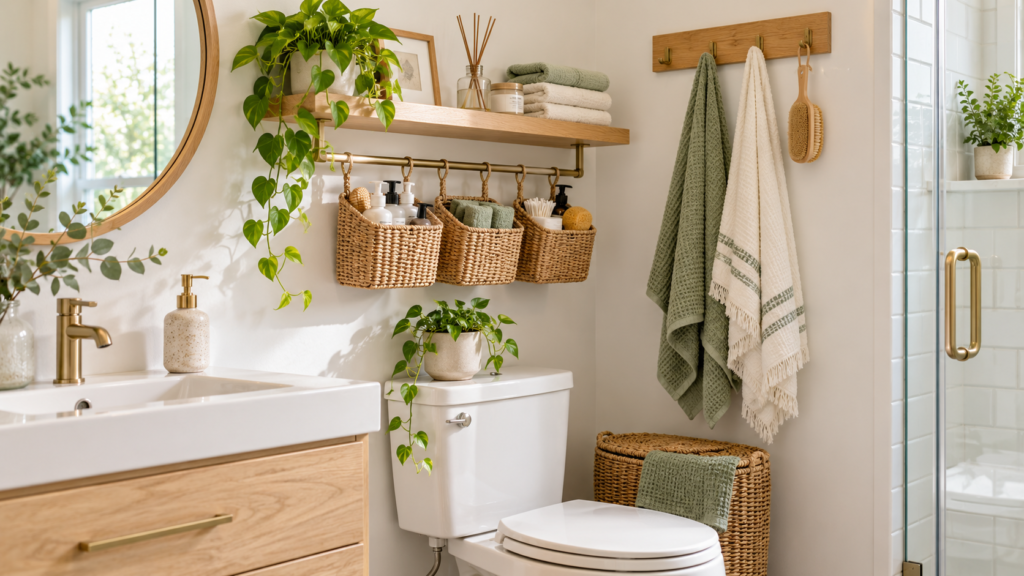
10. Create Separate Storage Zones for Everyday and Backup Items
One of the biggest mistakes in a small bathroom is mixing everything together.
Instead, divide your storage into two basic categories:
Everyday items
These are the things you use frequently:
- Toothpaste
- Skincare
- Shampoo
- Soap
- Hair products
- Grooming essentials
Backup items
These include:
- Extra toilet paper
- Unopened shampoo
- Replacement soap
- Extra cleaning products
- Spare toiletries
Keep everyday products within easy reach and move backup inventory into less accessible storage.
This simple change can make a small bathroom feel much easier to maintain.
How to Organize a Small Bathroom Step by Step
These small bathroom organization ideas can help you create a more functional space without remodeling.
You don’t need to buy ten organizers at once.
Start with the space you already have.
Step 1: Remove everything
Take items out of the countertop, drawers and under-sink cabinet.
Step 2: Discard what you no longer use
Check for:
- Empty containers
- Expired products
- Duplicate items
- Products you haven’t used in months
Step 3: Group similar products
Create simple categories such as:
Daily care → Hair → Skincare → Cleaning → Backup
Step 4: Identify wasted space
Look at:
- Above the toilet
- Behind the door
- Under the sink
- Corners
- Vertical wall space
- Empty gaps beside cabinets
Step 5: Buy organizers only after measuring
This prevents one of the most common small-space mistakes: buying an organizer that doesn’t actually fit.
Step 6: Give every category a home
Once everything has a defined place, maintaining the bathroom becomes much easier.
Small Bathroom Organization Mistakes to Avoid
Many small bathroom organization ideas look useful but can actually create more clutter if the storage doesn’t match your daily routine.
1. Buying organizers before measuring
An organizer is only useful if it fits the available space.
2. Overloading open shelves
Too many products can make an organized bathroom look cluttered again.
3. Ignoring moisture
Bathrooms are humid environments. Choose materials and products appropriate for the location.
4. Using every available surface
More storage isn’t always better. A small bathroom needs some visual breathing room.
5. Keeping everything on the counter
Daily essentials are fine. Backup products usually don’t need to occupy valuable countertop space.
6. Ignoring the door and vertical space
Small bathrooms often have more usable vertical space than floor space.
7. Using adhesive storage without checking the surface
No-drill solutions can be useful for renters, but adhesive performance depends on the specific product, surface and environment. Current renter-focused guides emphasize checking installation requirements rather than assuming every adhesive product is suitable for a humid bathroom.
How to Choose the Right Bathroom Organizer
Before buying anything, ask these five questions:
| Question | Why it matters |
|---|---|
| Where will it go? | Prevents buying the wrong size |
| What will it store? | Determines capacity |
| Is the area wet? | Helps determine suitable materials |
| Do I rent? | May rule out permanent installation |
| How often will I use it? | Determines accessibility |
For renters
Prioritize:
- Freestanding organizers
- Over-door storage
- Removable solutions
- Tension systems where appropriate
- Products specifically designed for damage-free installation
For homeowners
You have more options, including:
- Wall-mounted shelves
- Built-in storage
- Medicine cabinets
- Recessed shelving
- Vanity upgrades
What Should You Keep on a Small Bathroom Counter?
A practical small-bathroom countertop usually needs only the items you use frequently.
Good countertop candidates:
- Hand soap
- Toothbrush holder
- Small daily-use tray
- One or two frequently used skincare products
Better stored elsewhere:
- Backup toiletries
- Cleaning supplies
- Extra towels
- Rarely used grooming products
- Bulk packages
The less frequently you use something, the less reason it has to occupy prime countertop space.
Frequently Asked Questions
What are the best small bathroom organization ideas for limited space?
The most useful options usually involve vertical storage, over-the-toilet shelves, under-sink organizers, door storage, shower caddies and defined countertop zones.
How do I organize a small bathroom with little storage?
Start by decluttering, then divide items into daily-use and backup categories. Use vertical and overlooked spaces before adding large storage furniture.
How can I maximize storage in a small bathroom?
Use the area above the toilet, inside the vanity, behind the door, in corners and along vertical walls. Narrow rolling carts can also make use of otherwise unused floor gaps.
What are good bathroom organization ideas for renters?
Freestanding shelves, over-door organizers, removable storage and appropriately rated no-drill solutions can provide storage without permanent modifications. Always check the product’s installation requirements and your lease before installing adhesive or tension-based products.
How do I keep a small bathroom countertop organized?
Keep only everyday essentials on the counter and group related items on a small tray. Store backup and rarely used products inside cabinets or drawers.
How can I organize under a bathroom sink?
Use adjustable or pull-out organizers that work around plumbing. Measure the cabinet interior and pipe layout before choosing an organizer.
Are over-the-toilet shelves useful in small bathrooms?
They can be useful because they take advantage of vertical space above an area that already has a fixed function. Choose a stable design that leaves adequate clearance around the toilet.
How often should I declutter a small bathroom?
A quick monthly check is a practical starting point. Remove empty, expired or unused products before they gradually take over available storage.
What are the best small bathroom organization ideas for limited space?
The best small bathroom organization ideas focus on using vertical and overlooked spaces. Over-the-toilet shelving, under-sink organizers, shower caddies, door-mounted storage, narrow rolling carts, and drawer dividers can add useful storage without taking up much floor space. For very small bathrooms, prioritize frequently used items within easy reach and keep backup supplies in a separate storage zone.
Related Small Kitchen Organization Guides
If you are working on a small kitchen, these GRAPCY Hub guides can help you organize other storage areas:
- 15 Small Kitchen Organization Ideas That Actually Work
- 10 Spice Rack Ideas for Small Kitchens and Better Organization
- 12 Kitchen Cabinet Organization Ideas for Small Spaces
- 15 Small Kitchen Storage Ideas to Maximize Every Inch
- 15 Small Kitchen Countertop Organization Ideas
- 12 Small Pantry Organization Ideas for Better Storage
Final Thoughts
A small bathroom doesn’t need to feel crowded just because it has limited square footage.
The most effective small bathroom organization ideas aren’t necessarily expensive. They come from using vertical space, creating clear categories, keeping everyday items accessible and removing things that don’t need to occupy valuable space.
Start with the areas you already have—under the sink, above the toilet, behind the door, inside drawers and unused corners. Then add organizers only where they solve a specific storage problem.
The result should be simple: less searching, less clutter and a bathroom that is easier to use every day.
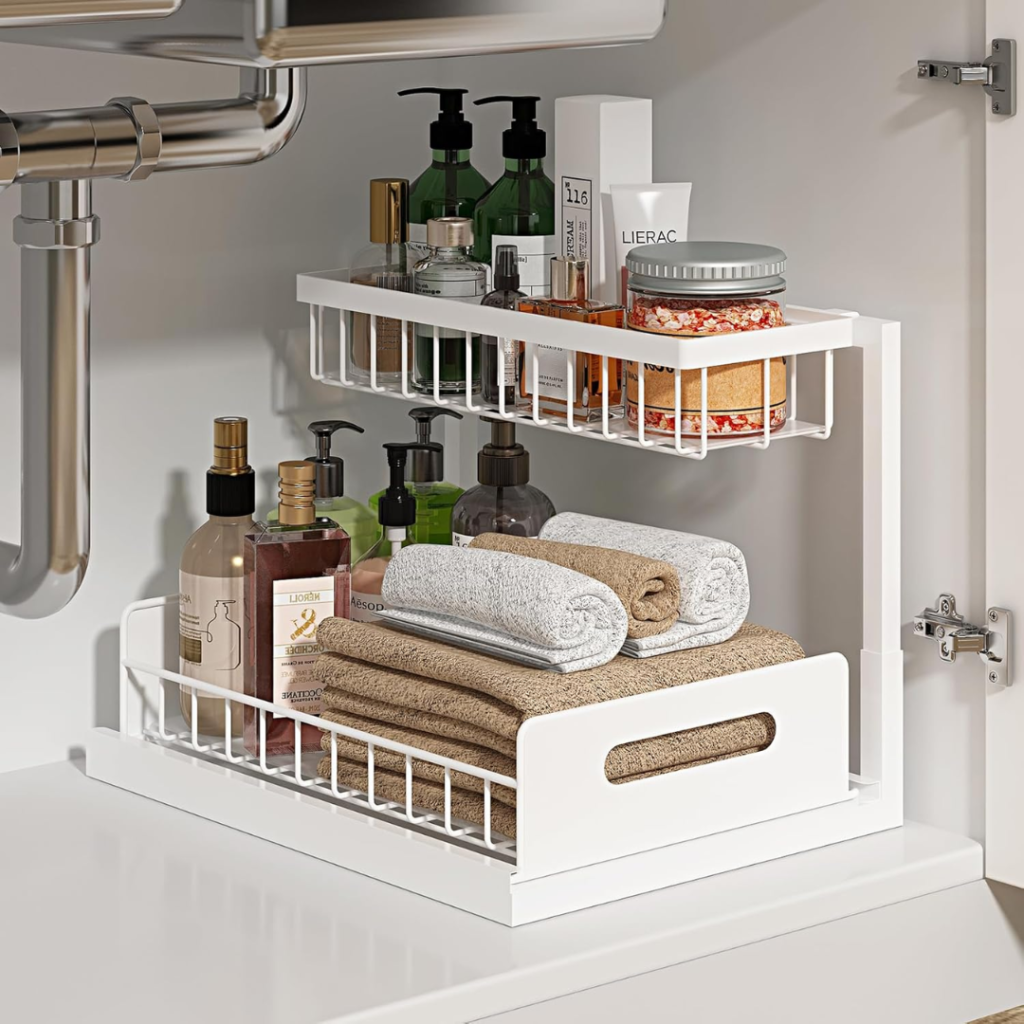
Sink Organizer
Key Features:
- L-Shaped 2-Tier Design – Makes use of vertical space while leaving room for plumbing and taller bottles.
- Pull-Out Drawer – Slides out from either side for easier access to items at the back.
- Tool-Free Installation – Includes suction cups and adhesive for stable placement without drilling.
- Sturdy & Rust-Resistant – Steel construction with a water-friendly grid design and removable pads.
- Versatile Storage – Great for under-sink cabinets, kitchens, bathrooms, and laundry areas.
- Size: 14.2 × 10.6 × 11 inches; bottom tier fits bottles up to 8 inches tall.
As an Amazon Associate I earn from qualifying purchases.