
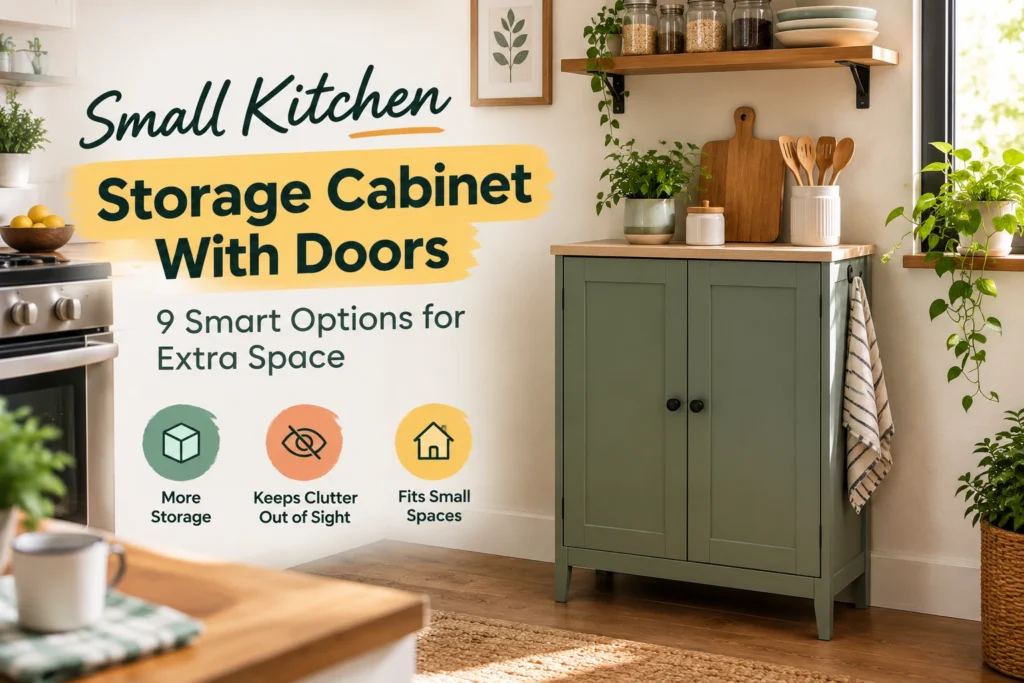
A small kitchen can feel cluttered quickly when food packages, cookware, small appliances, and everyday essentials have nowhere to go. A small kitchen storage cabinet with doors can create extra storage while keeping everyday mess out of sight. The key is choosing a cabinet that fits your available space, stores the items you actually use, and does not make the kitchen harder to move around in.
Whether you live in an apartment, rent a small home, or have limited pantry space, there are several cabinet styles worth considering. Some work best in narrow gaps, while others provide adjustable shelves, extra countertop space, or concealed storage for pantry staples.
In this guide, you will discover nine practical cabinet options, their pros and cons, and the measurements and features to check before buying.
9 Small Kitchen Storage Cabinet Ideas With Doors
The best cabinet depends on your kitchen layout, storage needs, and budget. Use these options as a starting point rather than assuming one style will work in every small kitchen.
1. Narrow Freestanding Storage Cabinet
A narrow freestanding cabinet can make use of an unused gap beside a refrigerator, at the end of a counter, or along an otherwise empty wall. Its doors help conceal food packages, kitchen towels, and other everyday supplies.
Before choosing one, measure the available width and the clearance needed to open the doors. A cabinet that fits the gap but blocks a drawer or walkway may create more problems than it solves.
Best for: Small apartments and kitchens with unused vertical space.
Pros
-
Uses narrow spaces that might otherwise go unused.
-
Keeps everyday supplies out of sight.
-
Can be moved if the layout changes, provided the unit is designed to be movable.
Cons
-
Narrow shelves may not accommodate large appliances or bulky cookware.
-
Tall models can become unstable if overloaded or left unsecured.
-
Door clearance can be difficult in tight layouts.
2. Compact Pantry Cabinet
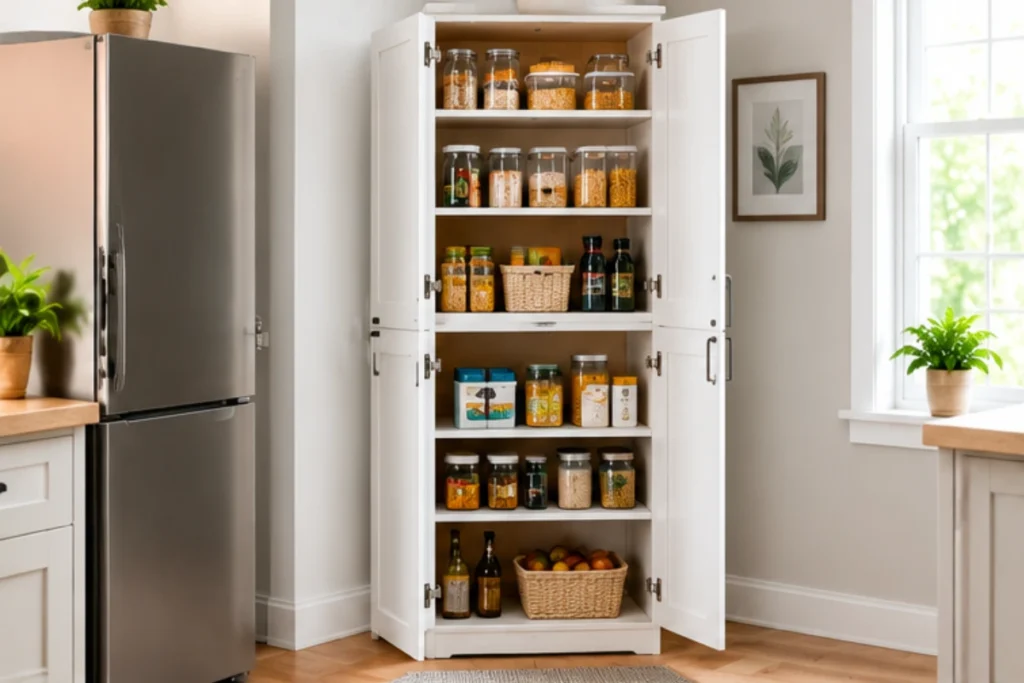
A compact pantry cabinet is useful when your kitchen lacks a dedicated pantry. Depending on its dimensions and shelf arrangement, it can hold dry goods, snacks, baking ingredients, and unopened food packages.
Look for adjustable shelves if you store items of different heights. Short shelves are useful for cans and spice jars, while taller spaces can accommodate cereal containers and larger packages.
Best for: Homes that need additional pantry storage without a full renovation.
Pros
-
Creates a dedicated location for dry food and pantry supplies.
-
Conceals packaging for a tidier appearance.
-
Adjustable shelves can make the interior more flexible.
Cons
-
Tall cabinets require adequate ceiling clearance and a stable installation.
-
Deep shelves can make items at the back difficult to reach.
-
Large pantry cabinets may take up too much floor space in very small kitchens.
Practical tip: Group food by category and place frequently used items at an easy-to-reach height. Avoid storing food in damp areas or next to heat-producing appliances.
3. Rolling Kitchen Storage Cabinet
A rolling cabinet combines enclosed storage with mobility. Some designs include shelves behind doors, drawers, or a worktop that can serve as an extra preparation surface.
This option can be useful when you need flexibility, but the wheels must be appropriate for the cabinet’s weight and the floor surface. Locking casters are particularly helpful when the unit is used as a work surface.
Best for: Renters and households that occasionally need to rearrange their kitchen.
Pros
-
Can be repositioned when additional space is needed.
-
Some models offer both storage and extra worktop space.
-
Enclosed compartments hide supplies and small appliances.
Cons
-
Wheels and handles add to the overall footprint.
-
Rolling units can move unexpectedly if the casters do not lock securely.
-
A worktop does not automatically make a cabinet suitable for heavy appliances.
4. Cabinet With Adjustable Shelves
If you store everything from short jars to tall bottles, an adjustable-shelf cabinet offers more flexibility than a unit with fixed shelf spacing.
Move the shelves to suit your current needs, and leave enough room to remove containers without scraping them against the shelf above. Check the manufacturer’s load limits before storing heavy dishes or small appliances.
Best for: Households with changing storage needs.
Pros
-
Shelf spacing can be adapted to different items.
-
Helps reduce wasted vertical space.
-
Can accommodate a mix of pantry goods and kitchen essentials.
Cons
-
Shelf adjustments may require removing stored items.
-
Lightweight shelves may flex under excessive weight.
-
The cabinet’s exterior dimensions still limit what it can hold.
5. Counter-Height Storage Cabinet
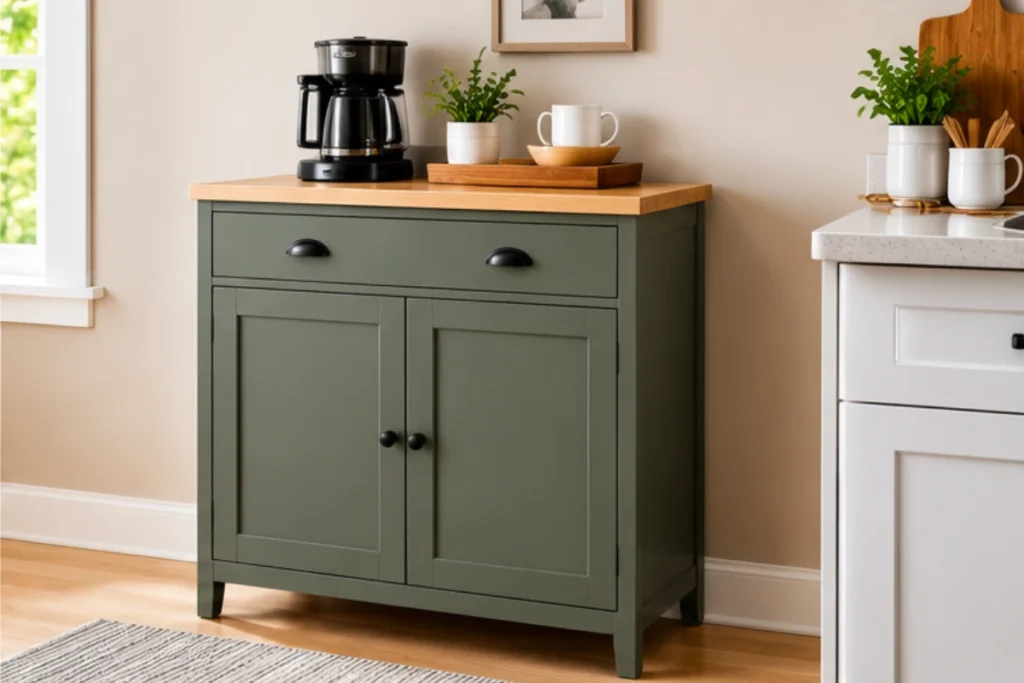
A counter-height cabinet can provide concealed storage and an additional surface for everyday kitchen tasks. Depending on its design, the top may be useful for a coffee station, a small microwave, or temporary food preparation.
Check the height, depth, and weight capacity before buying. A cabinet intended for decorative storage may not be designed to support a heavy appliance.
Best for: Kitchens that need both storage and additional usable surface area.
Pros
-
Can serve two purposes in a compact kitchen.
-
Keeps frequently used supplies within easy reach.
-
May help create a dedicated coffee or breakfast station.
Cons
-
Takes up floor space that could be needed for movement.
-
Not every top is suitable for food preparation or heavy appliances.
-
Items left on the surface can recreate the clutter you wanted to eliminate.
6. Corner-Friendly Storage Cabinet
Corners are often difficult to use efficiently, particularly when cabinet doors, drawers, and nearby appliances compete for space. A corner-friendly storage cabinet may help use an awkward area without extending far into the main walkway.
Measure both walls and check how the doors open. A cabinet may fit into a corner on paper but still interfere with an adjacent refrigerator, countertop, or doorway.
Best for: Kitchens with an unused corner or an awkward wall arrangement.
Pros
-
Makes use of an overlooked area.
-
Can provide additional enclosed storage.
-
May help keep supplies together instead of spreading them across counters.
Cons
-
Some corner designs have limited usable interior space.
-
Items at the back can be difficult to reach.
-
Door and handle clearance must be planned carefully.
7. Wall-Mounted Storage Cabinet
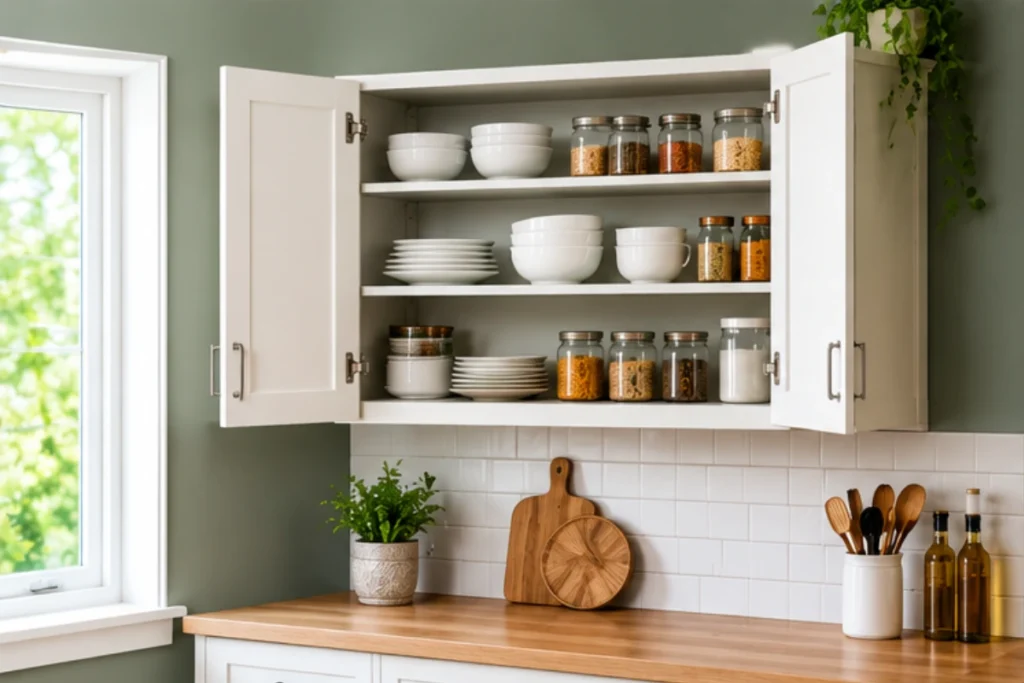
A wall-mounted cabinet keeps storage off the floor and can be useful in kitchens with very limited counter or floor space. It may hold lightweight dishes, mugs, dry ingredients, or other frequently used supplies, depending on the model and its installation.
Wall-mounted storage requires more planning than simply placing a cabinet on the floor. The wall structure, mounting hardware, cabinet weight, and contents all matter.
Best for: Kitchens where floor space is especially limited.
Pros
-
Frees up floor space beneath the cabinet.
-
Keeps selected essentials within easy reach.
-
Can make use of otherwise unused wall space.
Cons
-
Installation requires suitable wall support and hardware.
-
Not appropriate for every wall type or rental agreement.
-
Poor placement can make frequently used items difficult or unsafe to reach.
Safety note: Follow the manufacturer’s mounting instructions and load limits. Do not rely on adhesive strips or unsuitable fasteners to support a heavy cabinet.
8. Multi-Purpose Cupboard With Doors
A multi-purpose cupboard can store more than pantry food. Depending on its interior layout, it may accommodate lunch containers, serving dishes, paper towels, cleaning cloths, or small kitchen accessories.
The important consideration is whether the cabinet is designed for kitchen use. Check the material, shelf strength, finish, and ventilation before storing food or placing the unit near a sink.
Best for: Kitchens that need one dedicated place for mixed household essentials.
Pros
-
Can store several categories of supplies in one location.
-
Helps reduce visible clutter.
-
May be useful beyond the kitchen if the household layout changes.
Cons
-
Mixed storage can become disorganized without defined zones.
-
Some furniture cabinets are unsuitable for damp environments.
-
A large cupboard may overwhelm a compact room.
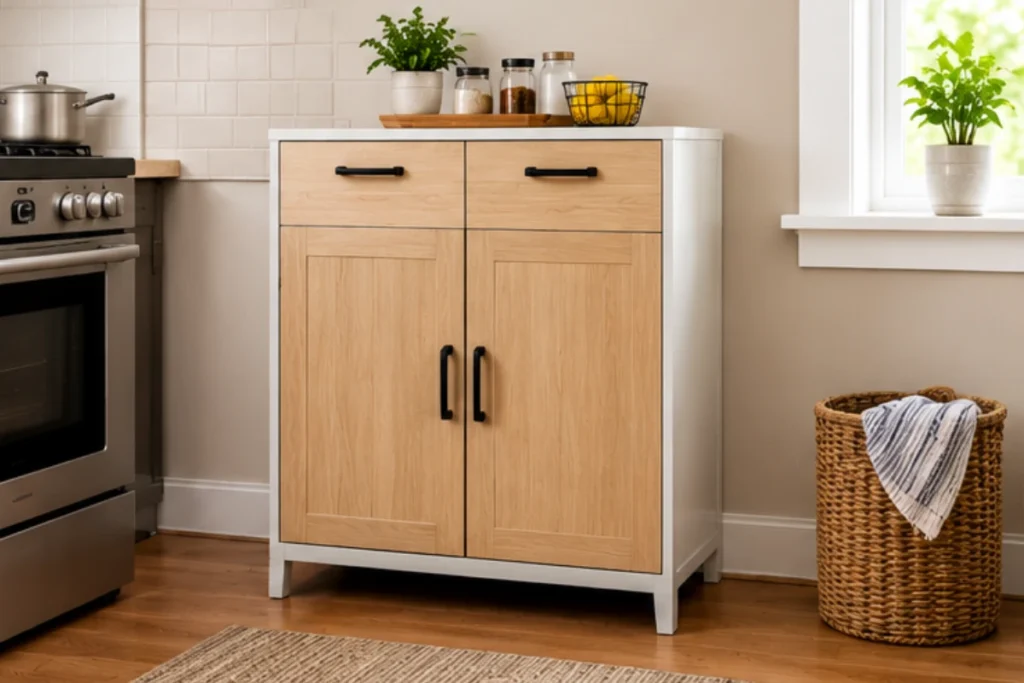
9. Compact Cabinet With Drawers and Doors
A cabinet that combines drawers with enclosed shelves can make the most of limited space. Drawers work well for smaller tools and accessories, while the area behind doors can hold larger containers or less frequently used supplies.
Look for drawers that extend far enough to make their contents accessible and doors that open without hitting adjacent furniture.
Best for: Kitchens that need both small-item organization and concealed bulk storage.
Pros
-
Separates small accessories from larger items.
-
Reduces the need for additional organizers.
-
Can make frequently used supplies easier to find.
Cons
-
More compartments do not always mean more usable capacity.
-
Drawer hardware and door hinges add potential maintenance needs.
-
Combined units may cost more than a simpler cabinet.
Quick Comparison: Which Cabinet Is Best for Your Kitchen?
| Cabinet type | Best use | Main advantage | Main drawback |
|---|---|---|---|
| Narrow freestanding | Unused wall gaps | Saves width | Limited shelf capacity |
| Compact pantry | Dry food and snacks | Dedicated food storage | Can occupy substantial floor space |
| Rolling cabinet | Flexible layouts | Mobility | Requires secure, stable wheels |
| Adjustable-shelf cabinet | Mixed-size items | Flexible interior | Shelf capacity varies |
| Counter-height cabinet | Storage plus work surface | Dual-purpose design | Needs floor space |
| Corner cabinet | Awkward corners | Uses overlooked space | Access can be difficult |
| Wall-mounted cabinet | Limited floor space | Keeps floor clear | Requires secure installation |
| Multi-purpose cupboard | Mixed supplies | Versatile storage | Needs clear organization |
| Drawers-and-doors cabinet | Small and large items | Multiple storage zones | More hardware to maintain |
How to Choose the Right Small Kitchen Storage Cabinet With Doors
A cabinet can look perfect online and still be wrong for your kitchen. Before ordering, check the following details.
1. Measure the Available Space
Measure the width, depth, and height of the intended location. Then check nearby doors, drawers, appliances, outlets, baseboards, and walkways.
Measure the entire space the cabinet will occupy, including handles and any overhanging top. If the unit must pass through a doorway or narrow hallway during delivery, measure that route too.
2. Check Door Clearance
Cabinet doors need room to swing open. In a tight kitchen, an open door can block a drawer, interfere with an appliance, or make it difficult for another person to pass.
Consider the direction of the hinges and whether the doors can open far enough for you to reach the shelves comfortably.
3. Compare Interior Storage Capacity
Exterior dimensions do not tell you how much useful storage a cabinet provides. Thick side panels, fixed shelves, drawers, and internal dividers can reduce usable space.
Check the internal shelf dimensions and weight limits. Choose a cabinet that fits the items you plan to store instead of paying for unused capacity.
4. Choose Materials for Your Environment
Cabinets may be made from solid wood, plywood, engineered wood, metal, or plastic. Each material has different durability, weight, maintenance, and price considerations.
For example, an engineered-wood cabinet may offer an attractive finish at a lower price, but prolonged moisture exposure can damage some finishes and board materials. Metal may be practical for certain utility spaces, while plastic can be useful where lightweight construction is a priority.
Read the manufacturer’s care instructions, especially if the cabinet will sit near a sink or dishwasher.
5. Look for Practical Features
Useful features may include adjustable shelves, soft-close hinges, sturdy handles, easy-to-clean surfaces, and locking casters on rolling units.
Prioritize the features that solve your actual storage problem. Extra drawers, decorative trim, or complicated hardware may not be worth paying for if a simpler cabinet fits your needs better.
6. Set a Realistic Budget
Compare the complete cost rather than the listed price alone. Assembly requirements, delivery fees, mounting hardware, and any separately sold accessories can affect the total.
Read recent customer reviews carefully, looking for repeated comments about assembly, stability, damaged parts, shelf strength, and whether the cabinet matches its advertised dimensions.
How to Organize a Cabinet Once You Bring It Home
A well-chosen cabinet can still become cluttered if everything gets placed inside without a plan.
-
Create categories: Keep baking supplies, snacks, cookware, and food containers in separate zones.
-
Use vertical space: Adjust shelves to fit the items you own instead of leaving large unused gaps.
-
Keep daily essentials accessible: Place frequently used items on comfortable, easy-to-reach shelves.
-
Use small bins selectively: Group loose packets and accessories so they do not spread across shelves.
-
Label containers when helpful: Simple labels can make shared storage easier to maintain.
-
Review stored items regularly: Remove expired food, duplicates, and things you no longer use.
-
Keep heavy items low: Store heavier cookware and bulky supplies on lower shelves, within the cabinet’s rated capacity.
The goal is to make items easier to find and put away. Avoid filling every inch if doing so makes shelves difficult to access.
Common Mistakes to Avoid
Buying before measuring: Even a compact cabinet can block an appliance or walkway if its dimensions are wrong.
Choosing looks over function: Attractive doors cannot compensate for shelves that are too shallow or an interior that does not fit your items.
Ignoring stability: Tall, narrow furniture may need to be secured to the wall according to the manufacturer’s instructions.
Overloading shelves: Respect the stated weight capacity, including the load on each individual shelf.
Putting a cabinet in a damp spot: Moisture can damage some materials and finishes. Check whether the product is suitable for its intended location.
Assuming every cabinet is food-safe: Store food in appropriate containers and follow the manufacturer’s guidance for cleaning and food contact.
Forgetting the delivery route: Confirm that the assembled or packaged cabinet can pass through entrances and hallways.
Frequently Asked Questions
What is the best small kitchen storage cabinet with doors?
The best option depends on your available space and what you need to store. A narrow cabinet may work well in an unused gap, while a compact pantry is better suited to dry food. A rolling cabinet may be useful when you need mobility and additional worktop space.
How deep should a small kitchen storage cabinet be?
There is no single ideal depth for every kitchen. Measure the available space and the items you intend to store. A shallower cabinet may work better in a narrow walkway, while deeper shelves can accommodate larger containers. Check the manufacturer’s interior dimensions rather than relying only on the exterior measurements.
Are freestanding kitchen cabinets good for apartments?
They can be a practical option because many models do not require permanent installation. However, renters should check their lease, the cabinet’s stability requirements, and whether the unit needs to be anchored to the wall.
Can I use a small storage cabinet as a pantry?
Yes, if it is suitable for the intended environment and offers enough shelf space for your dry goods. Choose a clean, dry location, use appropriate food containers, and keep items organized so you can check expiration dates easily.
Is a cabinet with doors better than open shelving?
Doors conceal visual clutter and can help protect stored items from everyday dust. Open shelving makes contents easier to see and access. A cabinet with doors may be preferable when you want a tidier appearance, while open shelves can work well for frequently used items.
What should I look for when buying a budget kitchen cabinet?
Check dimensions, shelf strength, material quality, stability, assembly instructions, customer feedback, and the total delivered cost. A lower-priced cabinet is not necessarily the best value if it does not fit your kitchen or cannot support the items you intend to store.
How can I make a small kitchen cabinet more useful?
Use adjustable shelves when available, group similar items together, store frequently used supplies within easy reach, and keep heavier items on lower shelves. Avoid filling the cabinet so tightly that items become difficult to remove.
Should I secure a tall kitchen storage cabinet to the wall?
Follow the manufacturer’s safety instructions. Tall or narrow cabinets can tip if they are overloaded or pulled forward, so use the recommended anchoring hardware and appropriate wall attachment. This is particularly important in homes with children or pets.
Related Small Kitchen Organization Guides
If you are working on a small kitchen, these GRAPCY Hub guides can help you organize other storage areas:
- 15 Small Kitchen Organization Ideas That Actually Work
- 10 Spice Rack Ideas for Small Kitchens and Better Organization
- 12 Kitchen Cabinet Organization Ideas for Small Spaces
- 15 Small Kitchen Storage Ideas to Maximize Every Inch
- 15 Small Kitchen Countertop Organization Ideas
- 15 Small Kitchen Storage Solutions That Make Every Inch Count
Final Thoughts
The right cabinet can give a small kitchen more organized storage without requiring a complete renovation. Start by measuring the available space, deciding what you need to store, and comparing the interior capacity of different designs.
A narrow cabinet can make use of an awkward gap, a compact pantry can organize dry goods, and a cabinet with drawers and doors can keep smaller accessories separate from larger items. Choose the design that fits your layout and daily routine rather than simply selecting the largest unit available.
With careful measurements and a clear storage plan, you can make better use of limited kitchen space while keeping everyday essentials accessible and clutter under control.
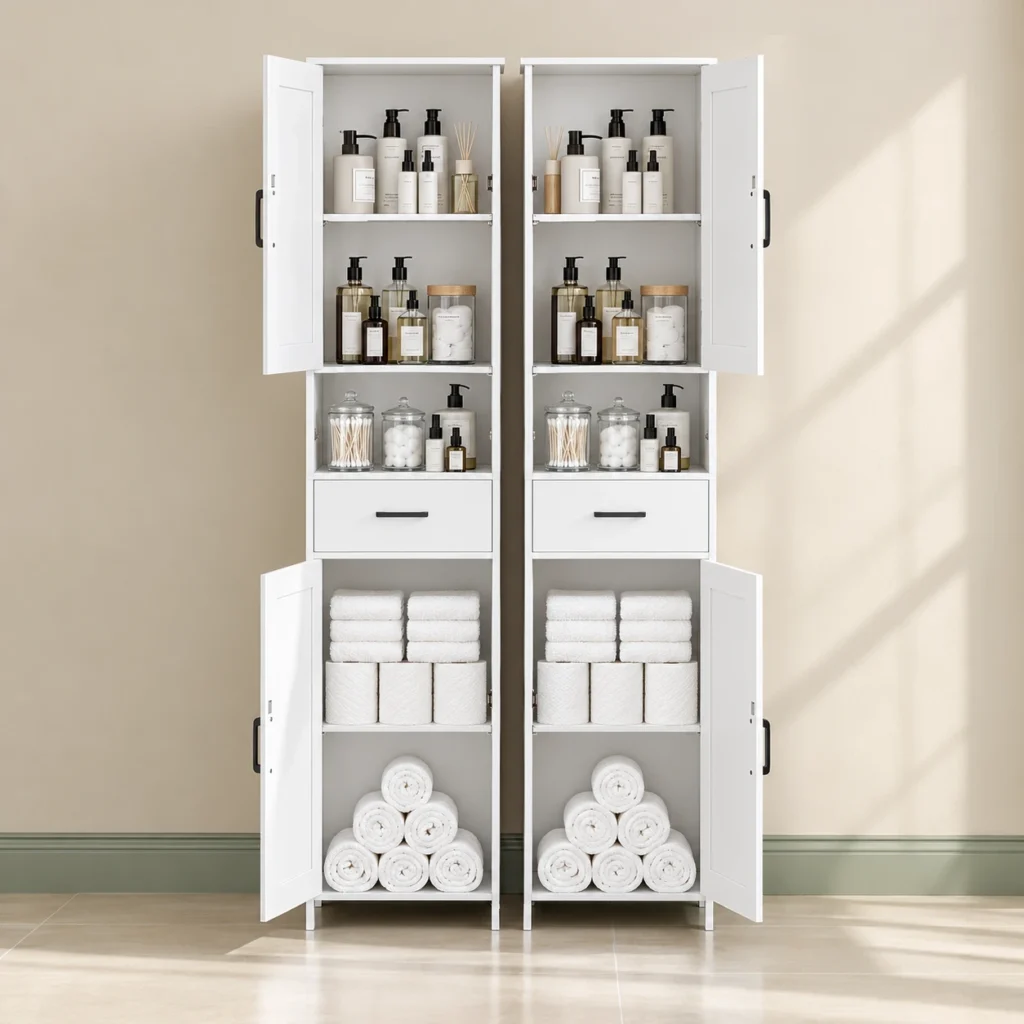
Bathroom Storage Cabinet
Key Features:
- Recommended Uses For Product– Towels, Toiletries, Kitchen Utensils.
- Product Dimensions – 11.8″D x 15.7″W x 66.9″H
- Weave Type – Tufted Item
- Weight 4.75 pounds.
- Multi-functional Storage.
- Reversible Door Opening.
- Adjustable Shelves.
- Multi-purpose.
- Sturdy and Safe
As an Amazon Associate I earn from qualifying purchases.